
Inside the Mecca Joint Deterrence Agreement — a mutual-defence pact that experts say will reshape the security architecture of the Middle East and South Asia.
Independent news report ·
The signing
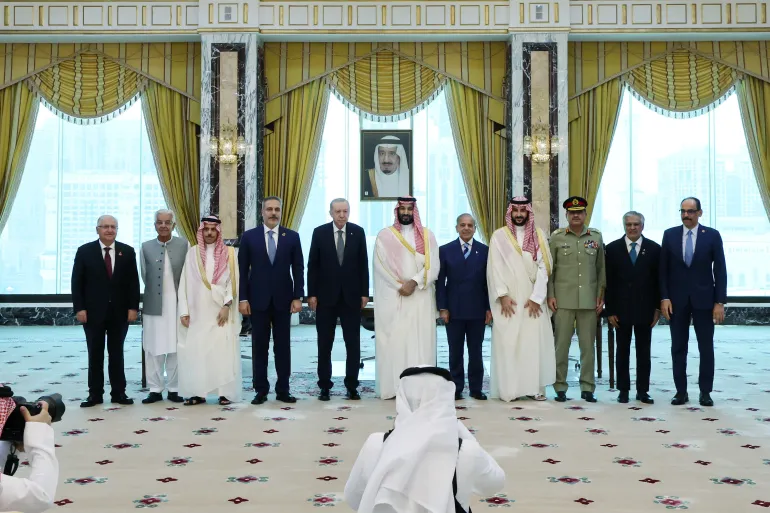
In the shadow of the holiest site in Islam, three of the Muslim world’s most powerful states put their names to a security pact modelled on NATO’s collective-defence clause. The Mecca Joint Deterrence Agreement, signed on 7 August 2026 at Mecca’s Al-Safa Palace, binds Saudi Arabia, Türkiye and Pakistan to treat an armed attack against any one of them as an attack against all [1][2].
The ceremony brought together Turkish President Recep Tayyip Erdogan, Saudi Crown Prince Mohammed bin Salman and Pakistani Prime Minister Shehbaz Sharif — each flanked by their foreign and defence ministers. Pakistan’s powerful army chief, Asim Munir, accompanied Sharif, who had arrived a day earlier after performing the Umrah pilgrimage [3].
The pact is the culmination of nearly a year of quiet diplomacy. Pakistan’s minister for defence production confirmed in January 2026 that a draft trilateral agreement had been circulating among the three capitals for ten months [4]. Bloomberg reported that same month that Türkiye was seeking to join the bilateral Saudi-Pakistan defence alliance signed the previous September [5]. On Friday, that architecture became real.
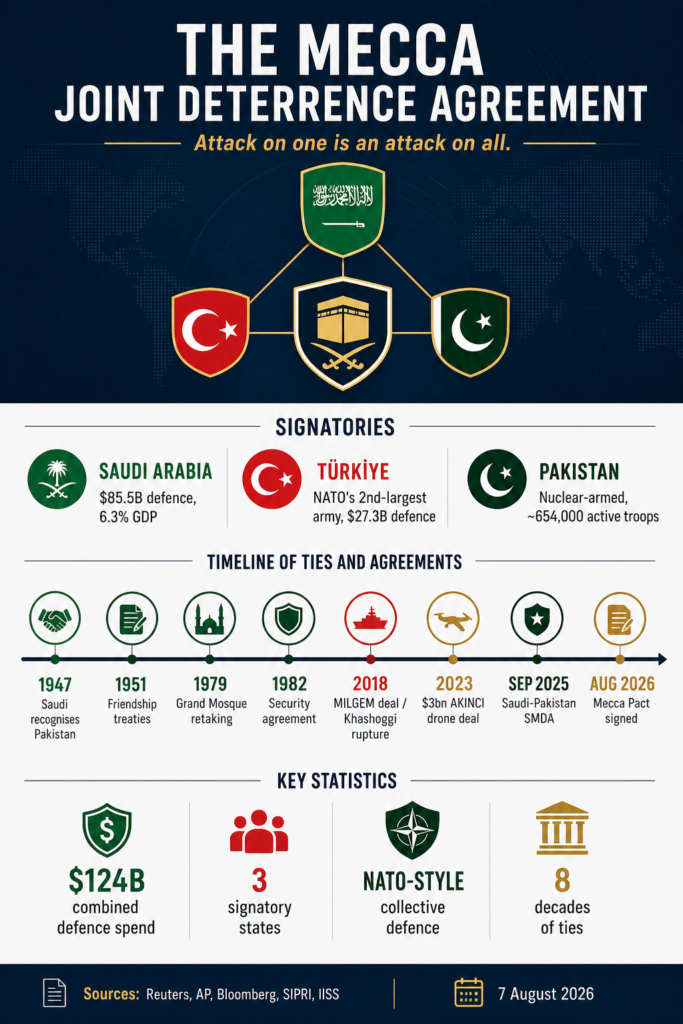
The numbers at a glance:
- 3 signatory states
- $124 billion combined annual defence spending
- NATO-style collective defence: “an attack on one is an attack on all”
- ~8 decades of Saudi-Pakistan ties
- 1951 Türkiye-Pakistan Treaty of Eternal Friendship
What the pact says
The agreement provides for “collective deterrence against any act of aggression” and stipulates that “any armed attack against any one of the three states shall be regarded as an attack against them all,” Pakistan’s Foreign Ministry said — language that closely mirrors Article 5 of the North Atlantic Treaty [3][6]. It also pledges to “enhance all aspects of defence cooperation” among the three.
“The agreement formalises a relationship which was previously a bit transactional.” — Pakistani Defence Minister Khawaja Asif, on the underlying bilateral pact [7]
The trilateral deal layers on top of the bilateral Strategic Mutual Defence Agreement (SMDA) that Saudi Arabia and Pakistan signed on 17 September 2025, which itself converted an “informal arrangement” dating back decades into a formal mutual-defence commitment [7][8]. Türkiye’s accession expands that two-country shield into a three-country one, and Ankara has signalled it hopes the platform could later admit regional heavyweights such as Egypt [9].
The forces at the table
The three signatories bring strikingly different but complementary assets. Saudi Arabia is the world’s seventh-largest military spender and brings oil wealth and strategic geography guarding Islam’s holiest sites. Türkiye contributes NATO’s second-largest standing army and a fast-growing, increasingly indigenous defence industry. Pakistan brings a nuclear arsenal, one of the world’s largest standing armies, and decades of combat experience [3].
Military spending, 2025–26:
| Country | Annual defence budget | % of GDP |
| Saudi Arabia | $85.5 billion | 6.3% |
| Türkiye | $27.34 billion | 2.33% |
| Pakistan | ~$11.7 billion | 2.4% |
Saudi Arabia spent an estimated $85.5 billion on defence in 2026 — about 6.3% of its GDP, among the highest shares in the world [10]. Türkiye’s parliament approved a $27.34 billion defence and security budget for 2026, a 30% increase on the prior year, and projects spending will climb to 3.2% of GDP by 2028 [11]. Pakistan raised its defence allocation by 20% for fiscal 2025–26 to roughly $9 billion, with total defence outlays (including pensions) reaching about $11.7 billion, after a May 2025 military clash with India [12].
Active-duty personnel (approximate):
| Country | Active-duty troops |
| Pakistan | ~654,000 |
| Türkiye | ~425,000 |
| Saudi Arabia | ~257,000 |
A history written in treaties
The Mecca pact did not emerge from nowhere. Each of the three bilateral relationships that converged on Friday rests on decades — in some cases centuries — of shared strategic interest, religious affinity and hard security cooperation.
Saudi Arabia & Pakistan: eight decades of brotherhood
Saudi Arabia was among the first countries to recognise Pakistan after its independence in August 1947. A 1951 Treaty of Friendship laid the foundation for strategic and military ties [13]. A bilateral training programme followed in 1967, through which Pakistan has trained more than 8,000 Saudi military personnel [13]. The pivotal moment came in 1979, when Pakistani special forces helped Saudi troops reclaim the Grand Mosque, Masjid al-Haram, after its seizure by militants [8].
In 1982 the two states institutionalised the relationship through a bilateral security agreement and the Organisation of Saudi-Pakistani Armed Forces, headquartered in Riyadh. At the height of the arrangement, as many as 15,000–20,000 Pakistani troops were stationed in the kingdom, with brigades at Tabuk and Khamis Mushait [14][15]. Pakistan defended Saudi territory during the 1990–91 Gulf War, and today an estimated 1,500 Pakistani personnel remain in advisory and training roles [16]. The relationship has not always been friction-free: in 2015, Pakistan’s parliament passed a resolution declining Saudi requests for troops in Yemen [16].
Türkiye & Pakistan: “two states, one nation”
Ankara and Islamabad bound themselves with a 1951 Treaty of Eternal Friendship and later stood together in the US-backed Baghdad Pact and its successor, CENTO [17]. A Military Consultative Group was formed in 1988, upgraded in 2003 to a High Level Military Dialogue [18]. Shared exclusion from Western arms pipelines — the US blocking T-129 helicopter engines for Pakistan and removing Türkiye from the F-35 programme over its S-400 purchase — has pushed the two toward joint production. Türkiye is now Pakistan’s second-largest arms supplier after China [19]. Landmark deals include a 2018 multibillion-dollar tender for four MILGEM corvettes — then the largest contract in Turkish defence-industry history — and ongoing cooperation on a fifth-generation fighter aircraft [19][20].
Türkiye & Saudi Arabia: from rupture to rearmament
The Turkish-Saudi relationship is the youngest leg of the triangle and the most turbulent. Ties deteriorated sharply during the Arab Spring, over Türkiye’s support for Qatar and the Muslim Brotherhood, and collapsed after the 2018 killing of Saudi journalist Jamal Khashoggi at the Saudi consulate in Istanbul. Riyadh imposed an informal ban on Turkish goods in 2020 [21]. The 2022 normalisation reversed course dramatically: in July 2023, Saudi Arabia signed a reported $3 billion deal for Baykar AKINCI combat drones — the largest single sale in Turkish defence history [22][23]. By 2025, Ankara was pursuing a $6 billion weapons package with Riyadh, potentially including warships, tanks and participation in Türkiye’s jet programme [24].
Milestones on the road to Mecca
| Year | Milestone |
| 1947 | Saudi Arabia among the first states to recognise Pakistan after independence [13]. |
| 1951 | Türkiye & Pakistan sign the Treaty of Eternal Friendship; Saudi Arabia & Pakistan sign a Treaty of Friendship [13][17]. |
| 1967 | Pakistan–Saudi military training programme begins; over 8,000 Saudis trained since [13]. |
| 1979 | Pakistani special forces help retake Mecca’s Grand Mosque after its seizure [8]. |
| 1982 | Saudi–Pakistan bilateral security agreement; up to 20,000 Pakistani troops stationed in the kingdom [8][14]. |
| 1990–91 | Pakistan deploys forces to defend Saudi territory during the Gulf War [16]. |
| 2018 | Türkiye wins multibillion-dollar MILGEM corvette tender from Pakistan; Khashoggi killing ruptures Turkish-Saudi ties [19][21]. |
| 2022 | Türkiye & Saudi Arabia normalise relations [21]. |
| 2023 | Saudi $3bn AKINCI drone deal — largest in Turkish defence history [22]. |
| 17 Sep 2025 | Saudi Arabia & Pakistan sign the Strategic Mutual Defence Agreement (SMDA) [7]. |
| Jan 2026 | Türkiye confirms it is seeking to join the Saudi-Pakistan pact; draft trilateral deal in circulation for 10 months [4][5]. |
| 7 Aug 2026 | Mecca Joint Deterrence Agreement signed by Erdogan, bin Salman and Sharif [1][2]. |
Why now: a region on fire
The timing is no coincidence. The pact was signed as the Middle East convulses under the US and Israeli war on Iran, which began with strikes on 28 February 2026 [25]. A fragile ceasefire has repeatedly faltered. In early July, the US launched new airstrikes on Iran; Tehran retaliated by hitting Bahrain, Kuwait, Qatar and Jordan, putting Gulf states that host American bases directly in the line of fire [26][27].
Days before the Mecca signing, Iran warned Gulf states that any renewed US attack on its territory would trigger retaliation against critical energy infrastructure across the region — a threat designed to raise the cost of military action and pit Washington’s Arab partners against it [28]. For Saudi Arabia, the calculation is stark: rely on a US security umbrella that has proven unreliable, or build a regional shield with partners whose interests align more closely with its own.
“The deal could reshape the strategic landscape in West Asia while prompting fresh questions for India.” — Analysis of the pact’s implications [6]
What’s in it for each player?
| Signatory | What it brings | What it gains |
| Saudi Arabia | Oil wealth, strategic geography, Gulf leadership | Security guarantees beyond the US umbrella; military-industrial partnerships |
| Türkiye | NATO’s 2nd-largest army, indigenous defence industry, drones | Influence in the Gulf; arms exports (AKINCI, corvettes, jets); strategic depth |
| Pakistan | Nuclear arsenal, large standing army, combat experience | Formalised Saudi security backing; defence-industry investment; financial support |
For Riyadh, the pact formalises security commitments that had long existed in practice, creating what analysts describe as a de facto joint defensive umbrella while reducing dependence on Washington [8]. For Ankara, it cements a Gulf foothold and a market for its booming defence exports. For Islamabad, the deal secures the backing of a wealthy patron at a moment of economic strain and strategic tension with India, while Türkiye’s defence cooperation and Saudi financial capacity could indirectly enhance Pakistan’s military resilience [6].
Questions the pact raises
The agreement leaves major questions unanswered. The full text has not been released; Pakistani officials have declined to disclose terms or implementation details [7]. It is unclear whether the mutual-defence clause is automatic or requires consultation, how it interacts with Türkiye’s NATO obligations, and whether it commits the three to come to each other’s aid in conflicts far from their borders — for example, a future India-Pakistan war [6].
The pact also reshuffles the deck for outside powers. For the United States, it signals that key regional partners are hedging against the unreliability of American security guarantees. For Iran, it means a stronger, more cohesive Sunni bloc on its doorstep. For India, it raises the prospect of Pakistan drawing on Turkish and Saudi military support in any future confrontation. And for the wider region, it marks the emergence of a security architecture built from within — rather than imposed from Washington.
The three leaders signed the document in Mecca, a city sacred to two billion Muslims. The symbolism was deliberate. The architecture it creates may outlast the war that prompted it.
Sources
[1] Turkey, Saudi Arabia, Pakistan to sign joint defence … (reuters.com)
[2] ‘Attack on one is attack on all’: Pakistan, Saudi Arabia and Turkey sign d… (humenglish.com)
[3] Saudi Arabia, Turkey and Pakistan have signed a key … (newsday.com)
[4] Pakistan-Saudi-Turkey defence deal in pipeline, Pakistani minister says |… (reuters.com)
[5] Expanded Saudi-Pakistan-Turkey Alliance Could Reshape Regional Power Balan… (bloomberg.com)
[6] Mecca defence pact between Pakistan, Saudi Arabia and Turkey raises strate… (zeenews.india.com)
[7] The Pakistan–Saudi Arabia defence relationship (iiss.org)
[8] Riyadh-Islamabad defence becomes a shared concern – Newspaper – DAWN.COM (dawn.com)
[9] Turkey seeks new defense platform with Saudi Arabia and Pakistan – Nikkei… (asia.nikkei.com)
[10] Saudi Arabia Military Spending 2026: $85.5B (defensebudget.org)
[11] Turkey begins 2026 with defense-spending numbers trending up (defensenews.com)
[12] Pakistan boosts defence budget by 20% but slashes overall spending in 2025… (reuters.com)
[13] ‘Watershed’: How Saudi-Pakistan defence pact reshapes region’s geopolitics… (aljazeera.com)
[14] Pakistan-Saudi Arabia Ties: Explaining the Shifts in Proximity (orfonline.org)
[15] Emerging Dynamics in Pakistani-Saudi Relations (files.ethz.ch)
[16] The signal and substance of the new Saudi-Pakistan … (brookings.edu)
[17] Turkey-Pakistan Security Relations since the 1950s (mei.edu)
[18] Pakistan-Türkiye Defense Case – DİPAM (en.dipam.org)
[19] Turkey and Pakistan: a special relationship? (iiss.org)
[20] Turkey, Pakistan to jointly develop fifth-generation fighter aircraft (janes.com)
[21] The Strategic Rise of Türkiye–Saudi Arabia Defense Cooperation: From Arms… (defenceturkey.com)
[22] Saudi Arabia signs major order for Turkish drones (defensenews.com)
[23] Weapons of Influence, How Arms-Centric Is the Turkey-GCC Countries Relatio… (prismeinitiative.org)
[24] Turkey Aims for $6 Billion Weapons Deal With Saudi Arabia – Bloomberg (bloomberg.com)
[25] Iran and US trade attacks as Strait of Hormuz ceasefire falters | US-Israe… (aljazeera.com)
[26] US launches airstrikes on Iran, Tehran fires back at Gulf states | AP News (apnews.com)
[27] Tehran hits Gulf states after US strikes, escalating regional tensions (npr.org)
[28] Iran threatens to hit Gulf states if US launches new strikes (reuters.com)