
Saudi Arabia · Turkey · Pakistan — Makkah Joint Defence Agreement, 7 August 2026
Written by: Munir Mengal
Executive Summary
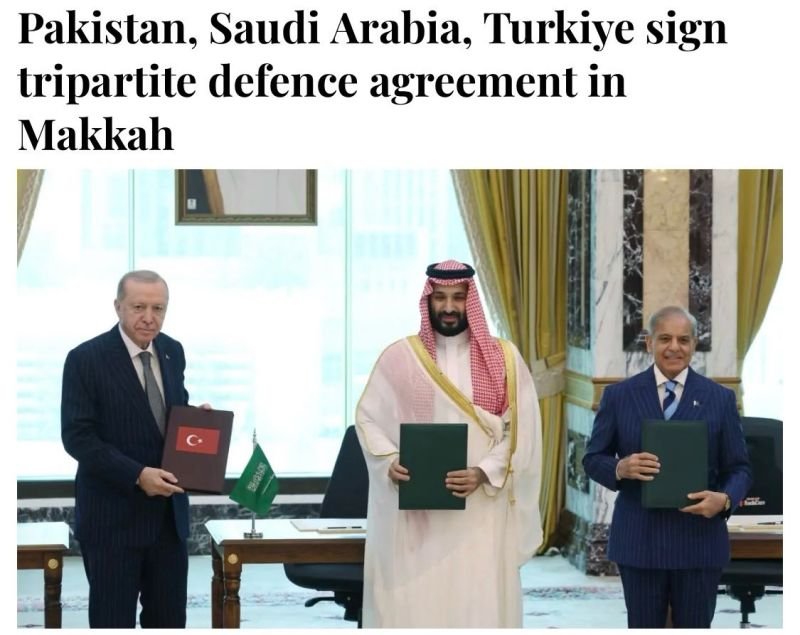
On 7 August 2026, Saudi Crown Prince Mohammed bin Salman, Turkish President Recep Tayyip Erdoğan, and Pakistani Prime Minister Shehbaz Sharif signed the Makkah Joint Defence Agreement at Al-Safa Palace in Makkah. The pact’s central provision stipulates that an armed attack against any one of the three signatories « shall be regarded as an attack against them all, » a NATO-style collective-defence formula that binds together a monarchy sitting on the world’s spare oil capacity, a NATO member with the alliance’s second-largest standing army, and the only Muslim-majority nuclear-armed state.
While the three governments have insisted the agreement is « purely defensive in nature » and « not against any specific actor, » the pact’s timing, composition, and omissions have generated deep unease across the region. This analysis examines the risks, concerns, and dangers the Makkah Agreement poses — particularly for the United Arab Emirates (UAE), Iran, and communities struggling for rights within Pakistan and Iran.
I. The Agreement in Context
What the Pact Says
The Makkah Joint Defence Agreement establishes a trilateral collective-defence framework. Its operative clause treats an armed attack on one signatory as an attack on all three. It builds on a bilateral Saudi-Pakistani mutual-defence pact concluded in September 2025, and emerges amid the ongoing US-Israeli war on Iran, repeated Houthi attacks on Saudi soil, disruptions to Red Sea and Gulf shipping, and a broader erosion of confidence in the American security umbrella.
What the Pact Does Not Say
The public text leaves critical questions unanswered. There is no disclosed procedure for determining that an attack has triggered the pact, no announced geographical limit, and no public explanation of what form of assistance each country is obliged to provide. This ambiguity is not accidental — it preserves strategic flexibility — but it also multiplies the risks of miscalculation, since potential adversaries and nervous neighbours alike must guess at the threshold for invocation.
The Symbolic Setting
Sealing the agreement in Makkah, Islam’s holiest city, was a deliberate choice. It lends religious and civilizational weight to the pact and frames it as an expression of Islamic solidarity. But that very framing carries exclusionary overtones: a pact sealed in the holiest site of Sunni Islam, uniting three Sunni-majority states, inevitably raises questions about who is inside the « ummah’s » new security architecture — and who is left outside it.
II. Risks and Concerns for the United Arab Emirates (UAE)
A. Structural Exclusion from a New Security Architecture
The UAE was not among the signatories, despite being one of the most militarily capable and economically influential states in the Gulf. The agreement may still expand to include other states — Egypt, Qatar, Syria, and the UAE have all been named as potential future members — but Abu Dhabi’s exclusion from the founding trio is conspicuous. The pact was brokered through a « Regional 4 Diplomatic Coordination Mechanism » comprising Pakistan, Turkey, Saudi Arabia, and Egypt — yet even Egypt did not sign, and the UAE was absent from the consultative framework entirely.
This exclusion risks marginalizing the UAE within a Gulf security order increasingly organized around Riyadh’s preferences. Saudi Arabia’s stated ambition to become an « organiser of regional security » and diversify its defence umbrella could, over time, subordinate Abu Dhabi’s independent strategic posture to a Saudi-led consensus.
B. Divergent Positions on Yemen, Israel, and Iran
The UAE’s positions have « repeatedly diverged » from those of the Makkah trio in recent years, most notably over Yemen and the normalisation of ties with Israel. These divergences are not minor:
- Israel and the Abraham Accords: The UAE is the bedrock of the 2020 Abraham Accords, having normalized ties with Israel. During the Iran war, the UAE moved closer to Israel, France, the United States, and the United Kingdom — citing disappointment with some of its closest Arab partners. An Israeli diplomatic source told CNN the UAE « found themselves alone — and Israel and the United States were there for them, » deepening military ties beyond what was envisioned at the Accords’ signing. The Makkah pact, by contrast, represents a security architecture that arguably hedges against Israeli power and « further distances Saudi Arabia from any near-term normalisation under the Abraham Accords framework. » The pact thus risks entrenching a rival regional grouping: an Israel-aligned bloc (UAE, Bahrain, Morocco, and their Western partners) standing against a Makkah-aligned bloc.
- Yemen: The UAE’s role and interests in Yemen have differed sharply from Saudi Arabia’s, and the Makkah trio’s approach to Houthi threats — which the pact implicitly addresses — may not align with Abu Dhabi’s calculations.
C. The Danger of Forced Alignment
The UAE now faces a strategic dilemma. If the Makkah pact matures into a genuine security bloc, Abu Dhabi may face pressure to either join on terms set by Riyadh and Ankara — constraining its independent relationships with Israel and the West — or remain outside, accepting diminished influence over the Gulf’s emerging security order. Neither option is comfortable. The pact’s « attack on one is an attack on all » formula, if extended to the UAE through future accession, could also drag Abu Dhabi into conflicts (for example, a Pakistan-India escalation or a Turkish confrontation with a NATO ally) that serve no Emirati interest.
III. Risks, Concerns, and Dangers for Iran
A. A Pact That Functions as a Warning to Tehran
Although all three signatories have insisted the agreement is not directed against Iran, the timing and context make its deterrent intent unmistakable. The CNN analysis is explicit: « The treaty signed in Mecca on Friday therefore serves as a warning to Tehran: another major attack on Saudi Arabia could invoke the pact, draw Pakistan and Turkey into the conflict and dramatically widen the war. » Iran had fired missiles and drones at Saudi Arabia, Kuwait, Bahrain, Qatar, the UAE, Oman, Jordan, and Israel during the regional war, and closed the Strait of Hormuz.
B. The Encirclement Paradox
The pact places Iran in a strategic paradox, as Al-Monitor observed: « the more Iran relies on asymmetric pressure through missiles, regional proxies and control over strategic waterways, the more neighbouring states could be willing to coordinate their own security arrangements. » The Makkah Agreement is the concrete expression of that dynamic. For Tehran, the pact risks completing a picture of strategic encirclement: a collective-defence bloc to its west (Turkey), south (Saudi Arabia and the Gulf), and east (Pakistan), all bound to treat an attack on one as an attack on all.
C. Iran’s Dual Reaction — and Its Dangers
Iran’s official response has been carefully calibrated. Foreign Ministry spokesman Esmaeil Baghaei said Tehran sees « no reason » to be concerned and framed the pact as evidence that regional countries have grown disillusioned with US security guarantees — a narrative favourable to Tehran. Foreign Minister Abbas Araghchi urged Muslim countries to unite against « hostile outsiders, » reframing the pact as Islamic solidarity rather than a bloc against Iran.
But beneath the conciliatory rhetoric, dissatisfaction is evident. Iranian MP Ebrahim Rezaei, a member of parliament’s National Security and Foreign Policy Committee, warned: « The Saudis should understand that a paper agreement with Turkey and Pakistan will not bring them security, just as decades of one-sided dependence on the Americans failed to do so. » An Iranian analyst noted that the agreement’s « core purpose is not so much to protect against Israel as to create a mechanism for confronting threats from Iran and its allies. »
This duality carries real danger. Iran’s official silence and studied ambiguity suggest a leadership that has « registered the development and has chosen to avoid granting it the recognition that a formal response would confer » — but the concerns are evident, and the unresolved question is whether the pact constitutes « a coalition assembling against Iran with identifiable targets in Yemen, Iraq, and eventually Iran itself. » The danger is that Iran, feeling encircled, may escalate its asymmetric operations — through proxies in Yemen, Iraq, and Lebanon, or through renewed maritime disruption — to test the pact’s credibility before it solidifies, precisely the kind of provocation that could trigger the collective-defence clause and widen the war.
D. The Risk to Iran’s Regional Proxies and Diplomacy
The pact complicates Iran’s relationships with its own network. If Turkey and Pakistan are now committed to defending Saudi Arabia against attack, Iran’s proxy forces in Iraq and Yemen — which have struck Saudi targets — operate under a new calculus. Pakistan, in particular, has played a mediating role between the US and Iran (brokering the « Islamabad Memorandum of Understanding »), and the pact risks compromising that mediator status by binding Islamabad to a defensive commitment that, in a crisis, could place it directly opposed to Tehran.
IV. Dangers for Communities Struggling for Rights in Pakistan
The Makkah Agreement’s implications for Pakistan’s internal politics are among its most concerning, yet least examined, dimensions. The pact deepens the military’s role in foreign policy and reinforces a securitised governance logic at a moment when rights communities in Pakistan are already under intense pressure.
A. The Military’s Expanded Role and Democratic Erosion
Pakistan’s army chief, General Asim Munir, travelled to Jeddah for the summit and was received alongside the civilian prime minister — a visual and substantive reminder of the military’s centrality to the pact. The 27th Constitutional Amendment, passed in November 2025, entrenched the military’s supremacy over civilian leadership. The Makkah Agreement, by binding Pakistan to collective-defence obligations negotiated largely through military channels, further consolidates the army’s grip on national security decision-making — at the expense of parliamentary oversight and democratic accountability.
B. The Baloch Community and the Baloch Yekjehti Committee (BYC)
The Baloch people in Pakistan’s largest and most resource-rich province have long reported marginalization, enforced disappearances, extrajudicial killings, and exclusion from the benefits of resource extraction. The Human Rights Commission of Pakistan (HRCP) has warned of a « grave » human rights crisis in Balochistan, documenting « continued enforced disappearances, shrinking civic space, erosion of provincial autonomy, and unchecked impunity. » The HRCP cautioned that « the risk of ethnic reprisals beyond the province was real and growing » and called for « principled leadership rather than further securitisation. »
The Makkah Agreement threatens to accelerate exactly the securitisation the HRCP warns against. The pact extends Pakistan’s security role westward, drawing Gulf and Red Sea crises into Islamabad’s strategic calculations. A Pakistan more deeply embedded in a Saudi-Turkish defence bloc — and more reliant on its military as the instrument of that commitment — is a Pakistan with even fewer incentives to address Baloch grievances through political dialogue rather than coercion. The Baloch Yekjehti Committee (BYC), a peaceful civil rights movement demanding accountability for enforced disappearances, has already been branded a « soft political wing » of the Baloch Liberation Army (BLA) by provincial authorities. BYC leaders, including Dr. Mahrang Baloch, have been detained under anti-terrorism laws — a « desperate attempt to criminalize political dissent and rights protests » that « inadvertently blurs the line between peaceful dissent and insurgency. » A state more invested in a regional military pact is a state with even more reason to treat domestic rights movements as security threats.
C. The Pashtun Community and the Pashtun Tahafuz Movement (PTM)
The Pashtun Tahafuz Movement (PTM), a grassroots rights movement that emerged from Pakistan’s historically marginalized borderland region, has articulated a broader critique of state violence, militarization, and structural inequality faced by Pashtuns. In October 2024, the federal government formally proscribed the PTM under Section 11B of the Anti-Terrorism Act, citing threats to national peace and security — a move condemned by Amnesty International and the HRCP as heavy-handed.
The Makkah pact deepens the danger for movements like the PTM. When a state’s foreign policy is organized around military alliances and collective-defence commitments, the institutional logic that treats ethnic-minority rights advocacy as a security threat is reinforced. The PTM’s experience — moving from « ordinary contention toward criminalization and, ultimately, the national-security framework » — is a pattern the pact risks reproducing at greater scale. Pakistan’s « long-standing fear of mobilization over ethnic grievances that could foment secessionism » already hinders political engagement with Pashtun and Baloch groups; a defence pact that heightens the perceived stakes of internal dissent makes such engagement even less likely.
D. Religious Minorities and the Blasphemy Architecture
Pakistan’s religious minorities — Christians, Hindus, Shias, Ahmadis, and Sikhs — face systemic discrimination, with blasphemy laws and forced-conversion mechanisms remaining potent tools of persecution. The Makkah Agreement, sealed in the holiest city of Sunni Islam and framed in the language of « Islamic solidarity, » risks reinforcing a majoritarian religious identity at the state level. A Pakistan whose international posture is defined through an explicitly Islamic-defence framework is a Pakistan in which the space for religious pluralism and minority rights may further contract. The pact’s symbolism — brotherhood and Islamic solidarity among three Sunni-majority states — offers little to communities that do not fit that identity.
V. Dangers for Communities Struggling for Rights in Iran
The Makkah Agreement compounds the already dire situation of Iran’s ethnic and religious minorities, who face systematic repression that has intensified dramatically during and after the war.
A. The Escalating Crackdown on Ethnic Minorities
UN experts have called on Iranian authorities to end the « escalating arbitrary detention, enforced disappearance, torture and other ill-treatment and arbitrary executions of ethnic minorities, particularly Kurdish and Baluch minorities. » In 2026 alone, at least 24 members of the Baluch minority and 22 members of the Kurdish minority have been executed, with many more at imminent risk. Since the Israeli-US missile campaign began in June 2025, Iranian authorities have arrested over 21,000 people, including dissidents, journalists, human rights activists, and members of the Kurdish, Balochi, Azerbaijani Turk, Ahwazi Arab, Baha’i, and Jewish communities.
The repression is structural. Iran Human Rights Monitor documents that « ethnic minorities represent a disproportionate share of political prisoners, death-row inmates, and executed individuals, » with the pattern « particularly evident among Baluch and Kurdish communities and intensified in recent years. » Charges such as « espionage, » « war, » and « rebellion » (moharebeh, Efsad-fil-Arz) are used as tools of repression, particularly against Kurdish citizens, and the death penalty is deployed « as a tool of state intimidation targeting ethnic minorities. »
B. How the Makkah Pact Deepens the Danger
The connection between the Makkah Agreement and the plight of Iran’s minorities is indirect but powerful:
- The « wartime governance logic »: Iran already treats ethnic-minority regions « not only as security zones but as active front lines » in a wartime framework. A pact that explicitly organizes a collective-defence bloc against Iran — and is understood in Tehran as such — will reinforce the regime’s narrative that the country is under siege, providing further justification for the securitization of minority regions. The more encircled Iran feels, the more it will repress those it suspects of being fifth columns.
- The espionage framing: Iran passed a law in October 2025 making espionage for Israel and the US automatically punishable by death. The Makkah pact, by aligning Pakistan and Turkey with Saudi Arabia against potential Iranian aggression, expands the universe of states Iran may treat as hostile, increasing the risk that members of ethnic minorities with cross-border ties (Kurds with links to Turkey, Baluch with links to Pakistan) will be accused of espionage or collaboration.
- The suppression of dissent under the guise of national security: When a state perceives an existential external threat, internal dissent is reclassified as treason. The Makkah Agreement, by sharpening Iran’s sense of confrontation with a Sunni-majority defence bloc, gives Tehran additional rhetorical ammunition to equate minority rights advocacy with foreign-backed subversion — the same logic already used to justify executions of Kurdish and Baluch activists.
C. The Kurdish and Baluch Communities — Cross-Border Dimensions
The Kurdish community spans Iran, Turkey, Iraq, and Syria. Turkey — a Makkah signatory — has its own fraught history with Kurdish rights and has conducted military operations against Kurdish groups. A pact that aligns Turkey with Pakistan and Saudi Arabia in a defence bloc creates a cross-border dynamic in which Iranian Kurds find themselves caught between a Tehran regime that represses them and a Turkish state that is simultaneously a Makkah partner and a suppressor of Kurdish political aspirations. The Baluch community spans Iran and Pakistan — both now linked through the pact (Pakistan as signatory, Iran as the pact’s implicit target) — creating a situation in which Baluch rights activists on either side of the border face suspicion from states that are strategically opposed yet share an interest in suppressing cross-border ethnic mobilization.
D. Religious Minorities — Baha’is, Christians, and Others
Iran’s Baha’i community, the country’s largest non-Muslim religious minority, faces systematic persecution including denial of education, employment, and property rights. The Makkah pact’s framing in terms of « Islamic solidarity » among Sunni-majority states does nothing to address — and may indirectly worsen — the position of religious minorities in Iran by reinforcing the region’s sectarian and religious-identity framing of politics. A region increasingly organized around Islamic-defence blocs is a region in which secular, pluralist, and minority-rights frameworks have even less standing.
VI. Systemic and Structural Risks
A. Ambiguity and the Risk of Miscalculation
The pact’s undefined trigger mechanisms, geographical limits, and assistance obligations create a high risk of miscalculation. An adversary (Iran, its proxies, or a third party) may misjudge whether a given action crosses the threshold for invocation, while the signatories themselves may disagree on whether and how to respond. As The Diplomat noted, « There is no disclosed procedure for deciding that an attack has triggered the pact, no announced geographical limit, and no public explanation of what assistance each country must provide. » This ambiguity is a feature in peacetime (it preserves flexibility) but a severe liability in crisis.
B. The « Islamic NATO » Label and Sectarian Framing
Despite Saudi insistence that the agreement « does not represent an effort to establish a military axis or a sectarian bloc, » the pact’s composition — three Sunni-majority states, sealed in Makkah — has been widely labelled an « Islamic NATO » or « Sunni NATO. » This framing, whether accurate or not, reinforces sectarian cleavages across the region, deepens Shia communities’ sense of exclusion, and provides Iran with a propaganda tool to rally its own population and proxies against a « Sunni bloc. »
C. Erosion of Mediation and Diplomatic Space
Pakistan’s role as a mediator between the US and Iran (the Islamabad MoU) is compromised by the pact, which binds Islamabad to a defensive commitment against potential Iranian aggression. Turkey, similarly, has positioned itself as a potential mediator in regional conflicts; the pact narrows that space. A region with fewer credible mediators is a region more prone to escalation.
D. The Multipolar Realignment Risk
The Gulf Times analysis warns that the Makkah Agreement could transform the Gulf’s security dilemma « from a predominantly regional confrontation between Iran and Saudi Arabia into a broader strategic contest involving the US and its allies on one side, and China, Russia and Iran on the other. » In this framing, the pact is not just a regional defence arrangement but « an early indicator of a new strategic order taking shape in the Gulf » — one that risks hardening bloc politics and reducing the room for pragmatic, issue-by-issue diplomacy.
VII. Conclusion
The Makkah Joint Defence Agreement is, on its face, a defensive pact born of genuine security anxieties — Iranian missile strikes, Houthi attacks, doubts about American protection, and the chaos of a region at war. Its signatories have been careful to insist it threatens no one.
Yet the risks it generates are real and multidimensional:
- For the UAE, the pact risks structural exclusion from a Saudi-led security order, pressure to align with positions (on Israel, Yemen, Iran) that diverge from Abu Dhabi’s interests, and entrenchment of a rival bloc to the Abraham Accords framework.
- For Iran, the pact risks encirclement, escalation of asymmetric responses, and the temptation to test the bloc’s credibility through provocation — the very dynamic that could trigger the collective-defence clause and widen the war.
- For communities struggling for rights in Pakistan — Baloch, Pashtun, religious minorities — the pact deepens the securitisation of governance, reinforces the military’s dominance, and provides additional justification for the repression of peaceful rights movements under the banner of national security.
- For communities struggling for rights in Iran — Kurds, Baluch, Ahwazi Arabs, Baha’is, and others — the pact reinforces a wartime governance logic that treats minority regions as front lines, expands the universe of states Iran may consider hostile (and thus the universe of people it may accuse of espionage), and sharpens the sectarian framing that marginalizes pluralist and minority-rights claims.
The deepest danger of the Makkah Agreement may be this: a pact designed to deter external aggression may, by its symbolism, composition, and ambiguity, internalise repression in the very states it binds and the states it confronts — leaving the region’s most vulnerable communities to bear the cost of a security architecture built above their heads.
Sources
- BBC News — Saudi Arabia, Turkey and Pakistan sign defence pact
- Dawn — Pakistan, Saudi Arabia, Turkiye sign tripartite defence pact
- AP News — Saudi Arabia, Turkey and Pakistan sign key defense agreement
- Reuters — Saudi Arabia, Turkey, Pakistan pledge mutual defence
- The Diplomat — The Mecca Pact Extends Pakistan’s Security Role Westward
- Al Jazeera — Will Pakistan-Saudi-Turkiye alliance create a new regional order?
- Al Jazeera — Turkiye, Saudi Arabia, Pakistan sign joint defence agreement
- CNN — Saudi Arabia turns to Muslim military heavyweights as Iran war closes in
- The Guardian — Saudi Arabia, Pakistan and Turkey sign NATO-style defence pact
- France 24 — Saudi Arabia, Turkey, Pakistan sign defence pact
- Al-Monitor — How Saudi-Turkey-Pakistan pact puts Iran’s regional strategy to test
- Al-Monitor — Saudi Arabia, Turkey and Pakistan sign defence pact
- The New Arab — How does Iran view the new Mecca Defence Agreement?
- Iran Analytica — How Iran Sees the « Mecca Defense Pact »
- Tribune (Pakistan) — Iran downplays concerns over Makkah pact
- Tribune (Pakistan) — Makkah pact: Pakistan moves to allay concerns
- TASS — Mecca agreement shows regional countries’ disillusionment with US
- Muslim Network TV — Makkah defense pact is not aimed at any country, says Türkiye
- Muslim Network TV — Allies welcome, rivals watch as Saudi, Türkiye and Pakistan forge defense pact
- Gulf Times — The Makkah Agreement: A new equation for Gulf security
- Daily Excelsior — Three Flags, One Shield: Inside the Makkah Pact
- Vigil Journal — The Mecca Pact Just Delivered a Eulogy for the Unipolar Era
- Alhurra — Egypt Left Out of Mecca Defense Pact
- Ynet — The Middle East’s new trio
- The National — Saudi Arabia, Pakistan and Turkey sign joint defence pact
- KBS Sidhu Substack — Mecca and the Metal
- Diplomacy & Law — Saudi Arabia–Turkey–Pakistan Defense Pact: Is It a New « Islamic NATO »?
- CNN — Israel and the UAE find common cause as the Iran war cracks old alliances
- BBC — UAE warns Israel that annexing West Bank would cross ‘red line’
- Middle East Eye — What are the limits of the UAE-Israel partnership?
- OHCHR — UN experts urge Iran to end escalating targeting of ethnic minorities
- The National — UN experts urge Iran to end escalating crackdown on ethnic minorities
- Al-Monitor — Iran tightens wartime crackdown across Kurdish, Baluch ethnic regions
- New Lines Institute — Punishing Vulnerability: Iran’s Minority Crackdown After the 12-Day War
- GHRD — Caught in the Crossfire: Iran’s Minorities in Times of War
- Iran HRM — Geography of Discrimination Against Ethnic and Religious Minorities in Iran
- USCIRF — 2026 Annual Report: Iran
- ANF News — UN experts call on Iran to end violations against Kurds and Baluch
- HRCP via Dawn — HRCP warns of ‘grave’ human rights crisis in Balochistan
- The Diplomat — Mahrang Baloch’s Conviction is a Pyrrhic Victory for the Pakistani State
- The Diplomat — How Anti-Terror Laws Became a Tool to Silence Dissent in Balochistan
- Cambridge Core — Borderland, Resistance, and Neo-Pashtun Consciousness: PTM
- New Bloom Magazine — Which Movements Get Negotiated With, and Which Become Security Threats
- Fair Observer — Security, Identity and the Pashtun Tahafuz Movement Discourse
- Al Jazeera — Why peace remains elusive in Pakistan’s troubled Balochistan
- Al Jazeera — ‘Army alone can’t neutralise grievances’: What fuels Balochistan violence
- ACLED — Pakistan battles rising militancy that risks spreading beyond the frontiers
- NCHR (Pakistan) — Report on Pakistan’s Compliance with CERD 2024
- IRF (Pakistan) — Briefing Paper: Situation of Religious Minorities in Pakistan
- Minority Rights Group — Advocating for employment equality for religious minorities in Balochistan
- Dawn — Senate caucus concerned about non-compliance with minority quotas