

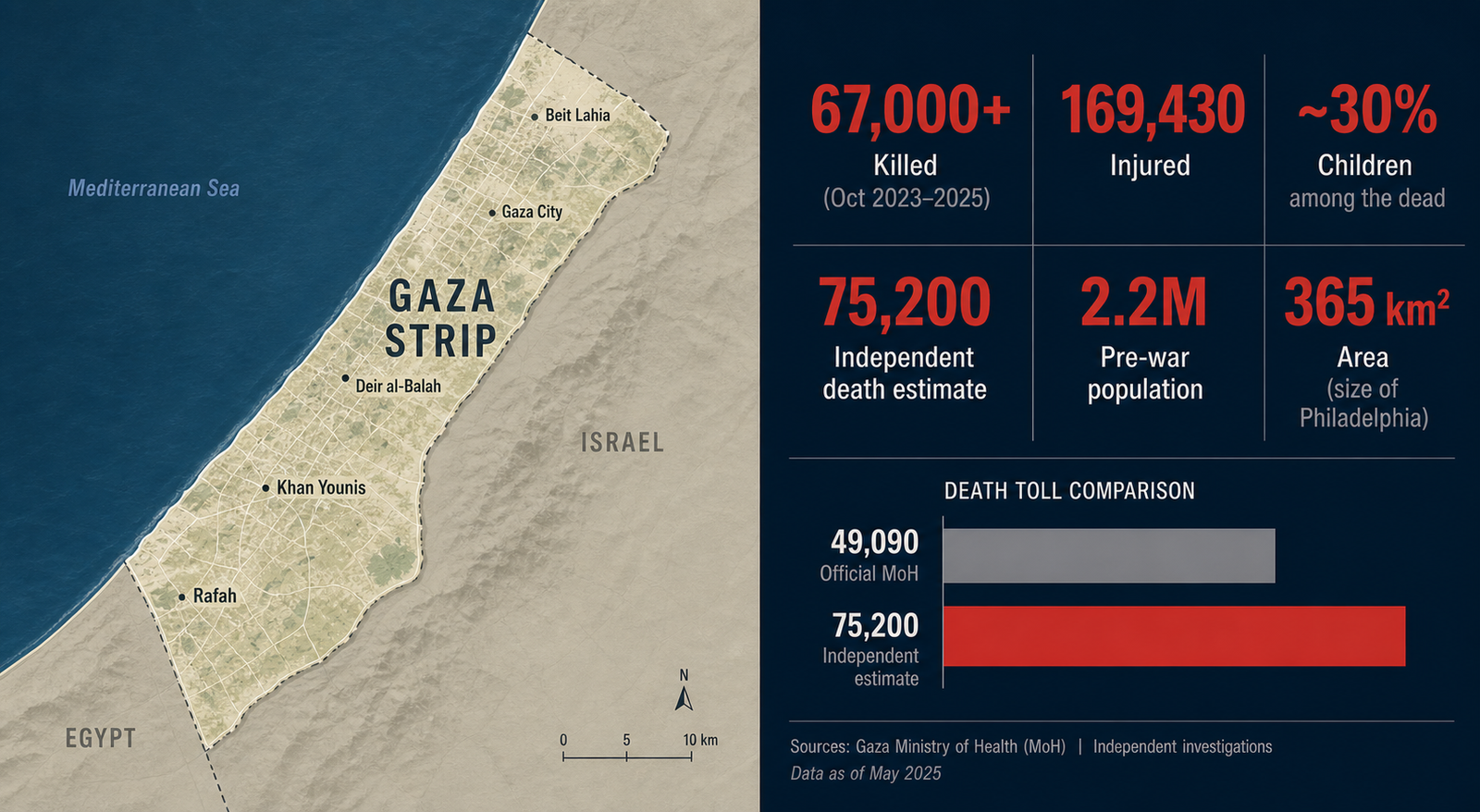
| GLOBAL AFFAIRS · SPECIAL REPORTThe Israel-Hamas War:Global Reaction and ConsequencesA documented account of the international response to the Gaza War — from the October 7 attack to humanitarian crisis, diplomatic realignment, and the surge in hate-fueled incidents worldwide. Research · Analysis · Reporting August 2026 · Research Report |
Executive Summary
The Israel-Hamas War, ignited by Hamas’s October 7, 2023 attack on Israeli communities, became one of the most consequential conflicts of the early 21st century. Beyond the battlefield, it triggered a deepening humanitarian catastrophe in Gaza, a wave of diplomatic realignment on Palestinian statehood, landmark legal proceedings on genocide, and a global spike in antisemitic and Islamophobic incidents.
This report synthesizes the war’s global reverberations through verified data and documented events, providing a clear, citable reference for readers, researchers, and policymakers.
The Human Cost at a Glance
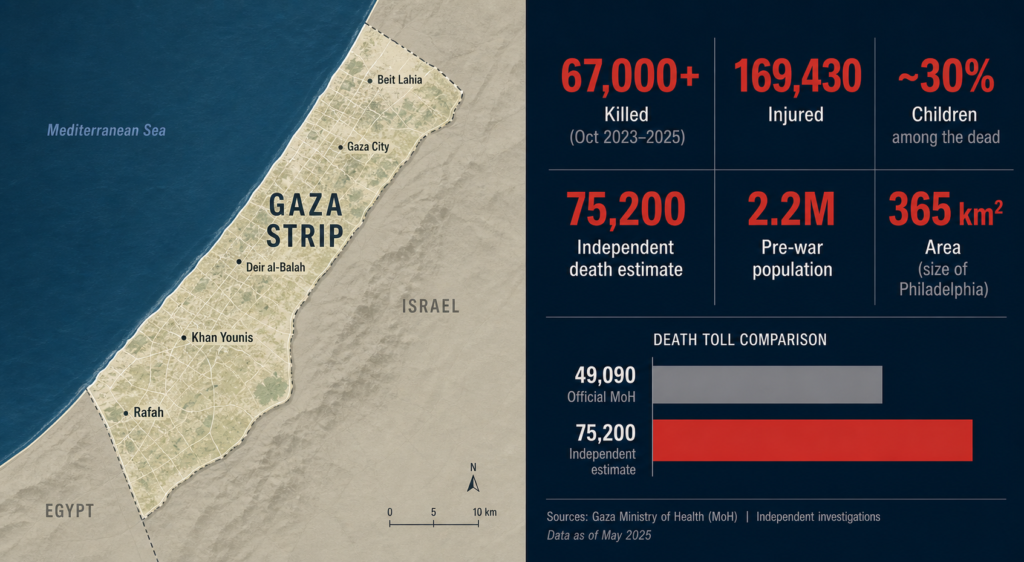
Two years of fighting produced a staggering human toll on both sides of the conflict. Figures below draw on Israeli government data, Gaza’s Ministry of Health, and independent peer-reviewed research.
| ~1,200Killed in Israel on Oct. 7, 2023 (mostly civilians) | 251Hostages taken into Gaza | 67,000+Palestinians killed in Gaza (Oct 2023 – Oct 2025) |
| ~30%Of Gaza dead who were children under 18 | 169,430Palestinians injured in Gaza | 75,200Estimated violent deaths by Jan 2025 (independent survey) |
Estimated Violent Deaths in Gaza: Official vs. Independent Estimates
Comparison of Gaza Ministry of Health figures with a population-representative field survey published in The Lancet Global Health.
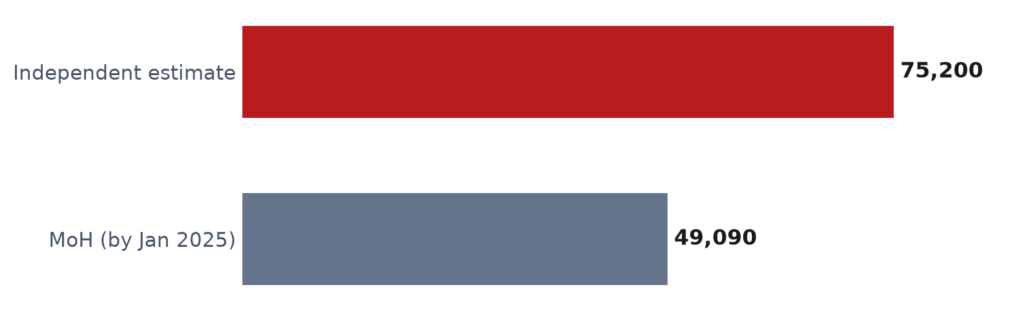
The independent survey estimated 75,200 violent deaths (95% CI 63,600–86,800) — roughly 34.7% higher than the MoH figure for the same period.
Background: How October 7 Came to Pass
The war’s roots lie in the broader Israeli-Palestinian conflict, which began in the early 20th century as both Jews and Arab Palestinians sought self-determination on the same land. The 1948 creation of the State of Israel and the ensuing hostilities displaced masses of Palestinians, many of whom became refugees in the Gaza Strip — a narrow territory roughly the size of Philadelphia that came under Egyptian control in the 1948–49 war. Israel occupied Gaza in the Six-Day War of 1967.
A brief hope emerged with the 1993 Oslo Accords between Israel and the Palestine Liberation Organization (PLO). Hamas, a militant group founded in 1987, rejected the plan and waged a terror campaign to disrupt it. The peace process collapsed amid suicide bombings and the 1995 assassination of Prime Minister Yitzhak Rabin. After Israel withdrew from Gaza in 2005, Hamas won elections in 2006 and seized control of the strip in 2007, prompting a blockade by Israel and Egypt.
Successive rounds of fighting (2008, 2012, 2014, 2021) never toppled Hamas but came at high civilian cost. By 2022, many analysts believed a pragmatic, deterred relationship had developed between Hamas and Israel. That assumption was shattered on October 7, 2023, when Hamas launched what it called Operation Al-Aqsa Flood.
| Israel was woefully unprepared. In August 2023, senior military officials had warned lawmakers that the IDF’s readiness for war had begun to weaken amid unprecedented domestic unrest over judicial reform. |
That domestic turmoil — mass protests and reservist strikes over the Netanyahu government’s attempt to bring the judiciary under legislative oversight — was later blamed for the IDF’s failure to prevent the attacks. A November 2024 independent Civilian Commission of Inquiry placed broad responsibility on the Israeli government, condemning Prime Minister Benjamin Netanyahu for undermining coordination between the political and military echelons.
Global Condemnation and Divergent Responses
The October 7 attack drew widespread condemnation worldwide. Hamas was denounced for terrorism against civilians by many Western governments as well as India, Japan, and South Korea. Other foreign ministries — including several Arab states, Turkey, Russia, and China — refrained from condemning Hamas specifically, instead urging restraint.
U.S. President Joe Biden pledged unequivocal support for Israel and, on October 18, became the first sitting U.S. president to visit Israel during wartime. Yet concerns quickly mounted that the conflict could take on global consequences: Houthi attacks on Red Sea shipping disrupted global trade, and U.S. troops in the region faced sometimes-deadly attacks.
Humanitarian Crisis and the Genocide Question
As the war produced a deepening humanitarian crisis in Gaza, Israel faced significant international pressure to allow aid into the territory. Accusations of genocide emerged as the offensive moved to southern Gaza. In December 2023, South Africa sought an injunction from the International Court of Justice (ICJ) to prevent violations of international genocide conventions; the following month the court ordered Israel to take all measures within its power to prevent genocide.
After humanitarian assistance was further restricted in 2025 — leading ultimately to famine — the UN Commission of Inquiry on the Occupied Palestinian Territory issued a report finding reasonable grounds to conclude that Israel had committed four of the five genocidal acts defined under the international Genocide Convention:
| Genocidal act (Genocide Convention) | Finding |
| Killing members of the group | Found |
| Causing serious bodily or mental harm | Found |
| Deliberately inflicting conditions of life calculated to bring about physical destruction | Found |
| Imposing measures intended to prevent births | Found |
| Forcibly transferring children of the group | Not found |
Diplomatic Realignment: A Wave of Recognitions
The war accelerated a remarkable diplomatic shift. Around 10 countries — including Mexico, Spain, Norway, and Ireland — successively recognized Palestinian statehood before the end of 2024. In July 2025, France became the first G7 country to announce its intention to recognize Palestinian statehood; the United Kingdom, Canada, Portugal, Malta, Australia, and Belgium made similar announcements in the following weeks.
As of late 2025, the State of Palestine is recognized by 157 of the 193 UN member states — roughly 81% of the international community.
Countries Recognizing the State of Palestine
Growth in recognition following the Gaza war (May 2024 – September 2025).
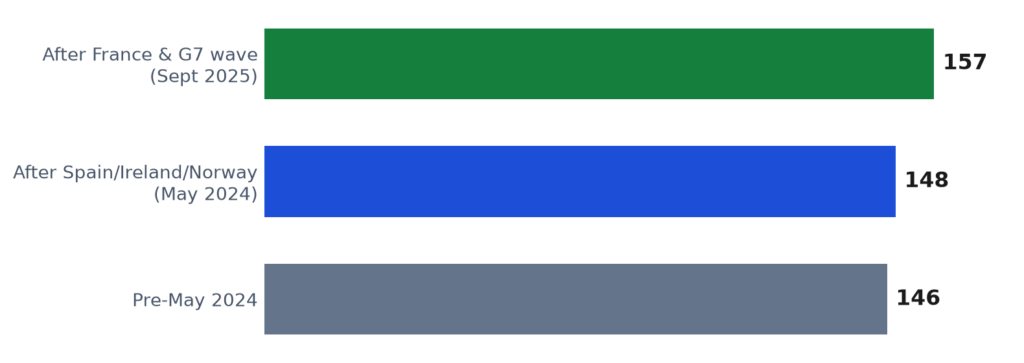
By the September 2025 UN General Assembly, 157 of 193 member states recognized Palestine.
The New York Declaration: A Landmark Vote
At the September 2025 UN General Assembly, France and Saudi Arabia jointly introduced the New York Declaration on the Peaceful Settlement of the Question of Palestine and the Implementation of the Two-State Solution. It called for the “irreversible implementation of the two-State solution,” for Hamas to free all hostages and disarm, and for UN member states to support a Palestinian state in the West Bank and Gaza.
On September 12, the General Assembly passed the resolution by an overwhelming margin.
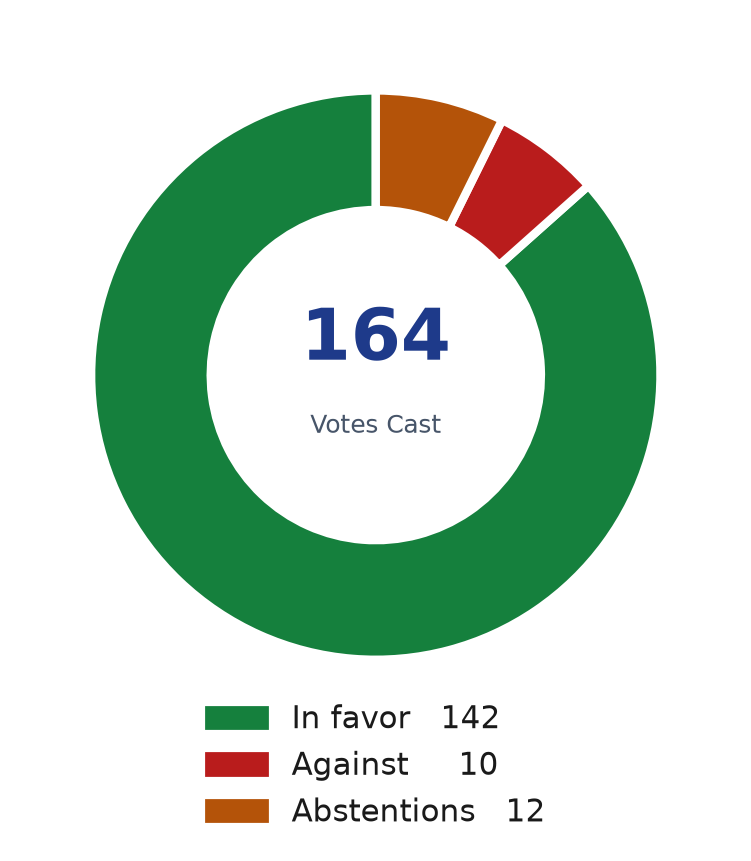
The 10 “no” votes: Argentina, Hungary, Israel, Micronesia, Nauru, Palau, Papua New Guinea, Paraguay, Tonga, and the United States.
The Surge in Hate-Fueled Incidents
The intense emotions surrounding the war drove a wave of antisemitism, Islamophobia, and anti-Arab and anti-Palestinian racism. In the first weeks of the conflict, U.S. watchdogs recorded dramatic spikes.
U.S. Hate Incidents in the First Weeks After October 7
Reported incidents in the comparable period one year earlier vs. after Oct. 7, 2023.
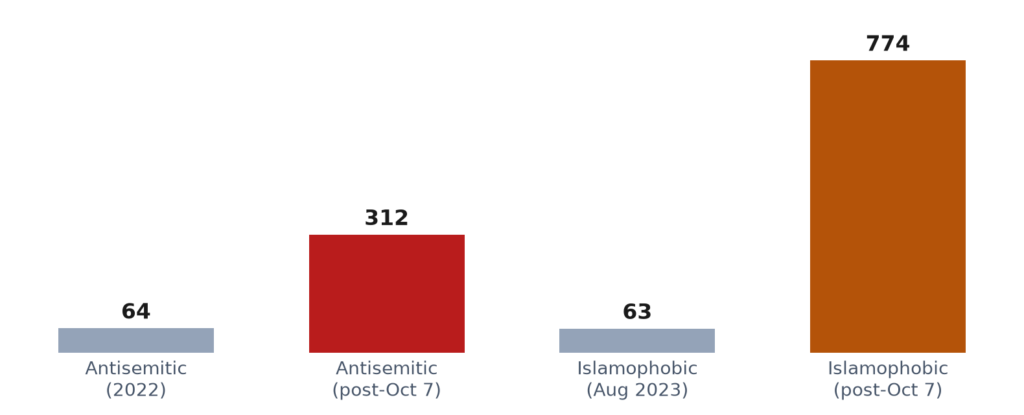
ADL recorded a 388% rise in antisemitic incidents; CAIR’s complaints represented the largest wave since 2015.
The atmosphere at American universities came under particular scrutiny. In April 2024, as Columbia University’s president testified before Congress, pro-Palestinian activists erected an encampment calling for divestment from Israel. Students at dozens of universities followed, causing significant disruption as graduation season approached. Tensions continued into 2025.
Harvard University, the only major university to conduct parallel investigations into both antisemitism and anti-Muslim/anti-Arab bias, found in twin task force reports released in April 2025 that:
| 26%of Jewish student respondents felt physically unsafe | 56%of Muslim student respondents felt physically unsafe | 61%of Jewish students & faculty feared voicing opinions | 92%of Muslim students & faculty feared voicing opinions |
Timeline of Key Events
| Oct 7, 2023 | Hamas launches Operation Al-Aqsa Flood; ~1,200 killed in Israel, 251 taken hostage. |
| Oct 18, 2023 | President Biden becomes first sitting U.S. president to visit Israel during wartime. |
| Dec 2023 | South Africa seeks ICJ injunction to prevent violations of genocide conventions. |
| Jan 2024 | ICJ orders Israel to take all measures within its power to prevent genocide. |
| Apr 2024 | Pro-Palestinian encampments spread across U.S. university campuses, beginning at Columbia. |
| May 2024 | Spain, Ireland, and Norway formally recognize Palestinian statehood. |
| Nov 2024 | Civilian Commission of Inquiry places broad blame on Israeli government for Oct. 7 failures. |
| 2025 | Humanitarian aid further restricted; famine conditions reported in Gaza. |
| Jul 2025 | France announces intention to recognize Palestinian statehood — first G7 country to do so. |
| Sep 12, 2025 | UN General Assembly passes New York Declaration: 142–10–12. |
Conclusion
The Israel-Hamas War reshaped not only the Middle East but the contours of international diplomacy, humanitarian law, and civic life far beyond the region. It exposed the limits of deterrence, reawakened the question of Palestinian self-determination at the highest diplomatic levels, and surfaced deep societal fractures in countries thousands of miles from the fighting.
With 157 nations now recognizing Palestinian statehood and the General Assembly endorsing a two-state roadmap by an overwhelming vote, the conflict’s global aftermath continues to unfold. The data and events documented here offer a baseline for understanding where the international community stands — and where it may yet go.
References
1. Brown University Costs of War Project. “The Human Toll of the Gaza War: Direct and Indirect Death from 7 October 2023.” (2025).
2. The Lancet Global Health. “Violent and non-violent death tolls for the Gaza conflict: new primary evidence from a population-representative field survey.” (Feb 2026).
3. United Nations. “General Assembly Endorses New York Declaration, Charting Path to Palestinian Statehood.” UN Meeting Coverage, Sep 12, 2025.
4. Associated Press. “UN overwhelmingly backs two-state solution to Israel-Palestinian conflict.” Sep 12, 2025.
5. Al Jazeera. “Which are the 150+ countries that have recognised Palestine as of 2025.” Sep 23, 2025.
6. Reuters. “Spain, Ireland and Norway recognise Palestinian statehood.” May 28, 2024.
7. Anti-Defamation League (ADL). “ADL Records Dramatic Increase in U.S. Antisemitic Incidents Following Oct. 7.” Oct 25, 2023.
8. Council on American-Islamic Relations (CAIR). “CAIR Reports Sharp Increase in Complaints, Reported Bias Incidents Since 10/7.” Oct 25, 2023.© 2026 Research & Analysis. All rights reserved. This report is provided for informational and educational purposes. Data figures reflect sources cited as of their respective publication dates and may be updated as new information becomes available.