

Geneva Policy Forum — 2 September 2026
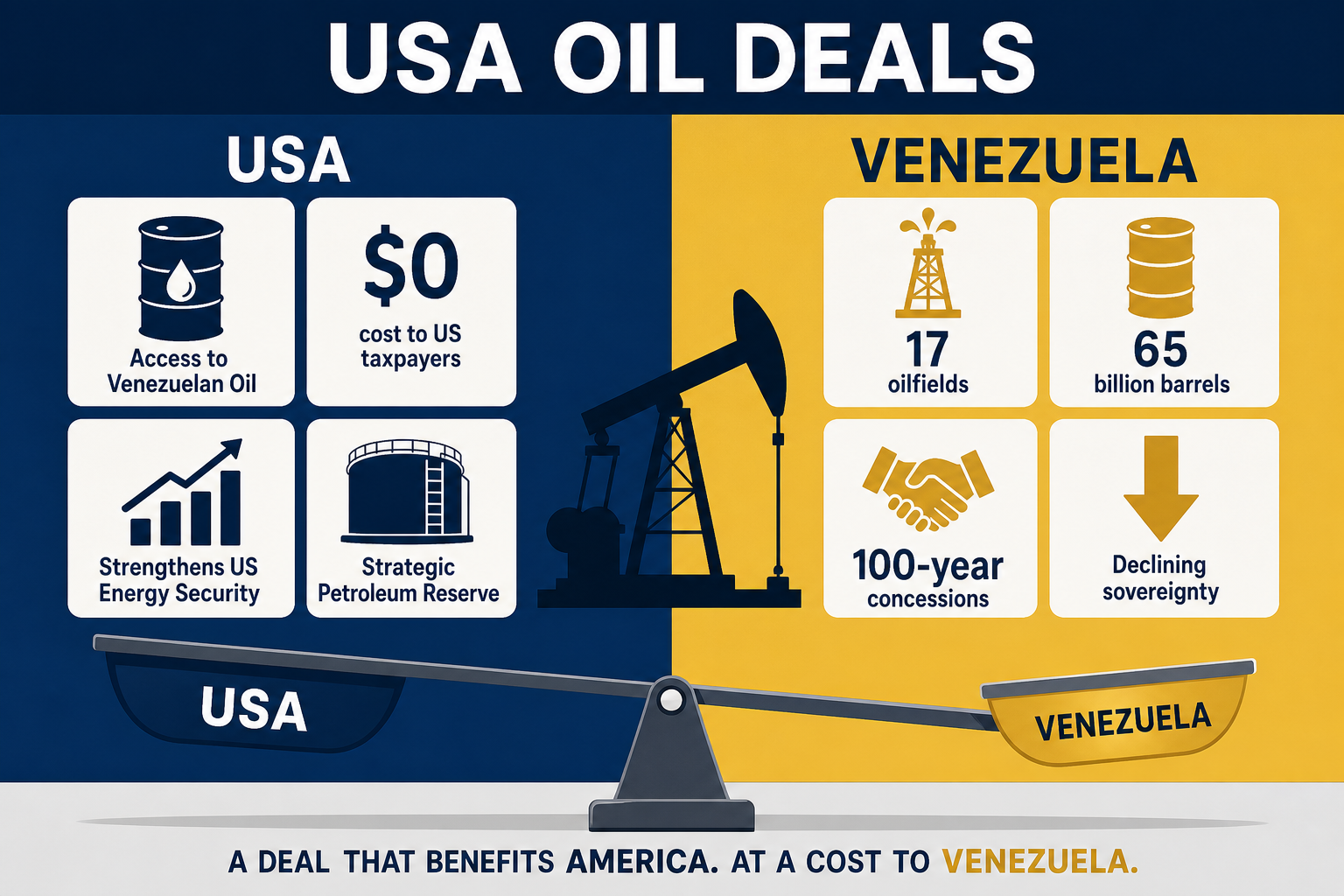
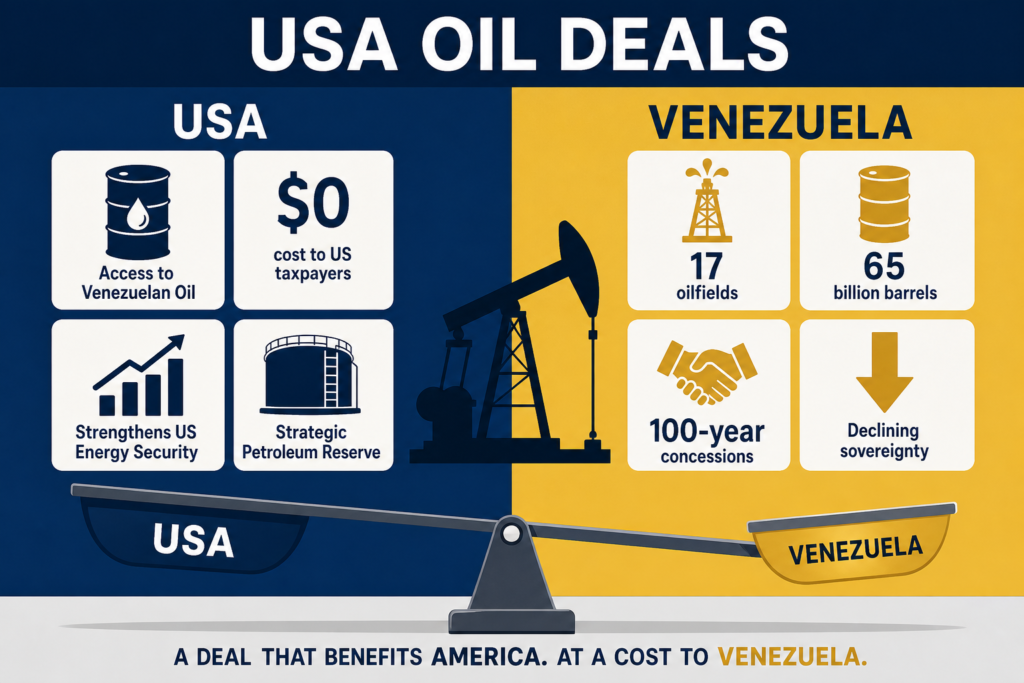
On Wednesday in Caracas, the United States and Venezuela signed an oil agreement of unprecedented scope, granting a US-led company 100-year concessions over 17 oilfields containing an estimated 65 billion barrels of crude — more than a fifth of Venezuela’s total proven reserves. President Donald Trump hailed it as « the biggest oil deal in world history, » while Venezuela’s interim President, Delcy Rodríguez, called the accord « historic, » projecting $100 billion in investment and over $200 billion in tax revenue for the Venezuelan state .
Beyond the eye-watering numbers, the deal represents a fundamental realignment of power over one of the world’s largest hydrocarbon reserves — and has provoked a rare consensus of opposition spanning the entirety of Venezuela’s fractured political spectrum, from orthodox Chavistas to the democratic opposition, as well as sharp criticism from within Washington’s own foreign policy establishment.
The Architecture of the Agreement
The deal centres on a private company, North American Blue Energy Partners (NABEP), which the White House confirmed on Monday will serve as the operational vehicle for the agreement. Under its terms, the Venezuelan government granted NABEP 100-year concessions to drill in 17 oil fields located in Lake Maracaibo and the Orinoco Belt, containing roughly 65 billion barrels — about one-fifth of Venezuela’s total proven reserves .
The agreement makes the US government the majority partner in a new joint venture, with 55% effective output rights, including an ownership stake and rights to buy oil at cost. American purchases of the oil will flow towards the US Strategic Petroleum Reserve and the military. The initial term is 25 years, renewable, with a production target exceeding 1.5 million barrels per day .
According to Reuters, 14 of the 17 projects will be newly granted by the Venezuelan government, while NABEP will also take over oilfields previously controlled by several Chinese companies and a Russian firm — a detail that underscores the geopolitical dimensions of the arrangement, as Washington displaces Beijing and Moscow from a strategic energy asset in its own hemisphere .
NABEP was previously owned by US oil tycoon Harry Sargeant and is now controlled by a Venezuelan businessman, Alejandro Ceballos, according to US officials — a structure that has raised questions about the blurred lines between private enterprise and state interests in the deal’s execution .
The Political Context: How We Got Here
The agreement cannot be understood in isolation from the dramatic political upheaval in Venezuela this year. In January, a US military operation seized then-President Nicolás Maduro in a nighttime raid and transferred him to New York to face federal charges. Delcy Rodríguez, who had served as Maduro’s vice president, was installed as interim president with Washington’s backing .
Rodríguez — the daughter of a Marxist guerrilla who spent years denouncing « imperialist » attempts to seize Venezuela’s oil — has now signed an opaque deal granting a US-led entity control over a fifth of the country’s most valuable natural resource. For observers who have followed her career, the irony is inescapable. It was just two years ago that, as Maduro’s vice president, she accused opposition leader Maria Corina Machado of taking orders from her « master » in Washington to « hand over the oil, gas, and gold » .
The deal was struck during months of secret talks, and its details remain sparse. The secrecy surrounding the negotiations has itself become a flashpoint, with critics across the political divide questioning the institutional legitimacy of an interim government committing the country’s primary source of wealth for the next century .
A Rare Convergence of Criticism
What makes the reaction to this deal remarkable is that it has united voices that normally stand on opposite ends of Venezuela’s political spectrum.
From the Chavista Left
Rafael Ramírez, who served as head of the state-run energy firm PDVSA and oil minister under former President Hugo Chávez, condemned the agreement in stark terms. The deal « hands over [the oil] and opens the doors to a new colonialism of the United States, » he said. For hard-line Chavistas, the concession to a private US operator dismantles the energy sovereignty achieved through the nationalisations of the Chávez era. Some have described the arrangement as Venezuela being forced to give away oil under US threat .
From the Democratic Opposition
The traditional opposition has been equally scathing, albeit for different reasons. Opposition figures argue that Rodríguez’s interim government lacks the constitutional legitimacy to commit the country’s primary source of wealth for the next 100 years. Economist Francisco Rodríguez urged the national assembly to reject what he called a « predatory deal, » arguing that « handing over Venezuela’s oil wealth to the US contravenes the constitution and is not in the interest of the Venezuelan people — much more when it is done at gunpoint » .
One well-known opposition figure, speaking anonymously, was even more blunt: « It’s a land grab — a massive land grab. It’s revolting because this is not the United States one would have expected. This is not the United States of the Marshall Plan. This is a rapacious, mafioso United States » .
The opposition is also concerned that the deal deepens Trump’s relationship with Rodríguez, whom they accuse of heading the same regime as Maduro — a figure they had hoped the US operation would dismantle rather than rebrand .
From Washington’s Own Ranks
Perhaps the most striking criticism came from within the US foreign policy establishment itself. Elliott Abrams, Trump’s former special representative on Venezuela and Iran, slammed the pact as a « terrible deal. »
« [Rodríguez] has given away 20% of the national patrimony for nothing, » Abrams said. « I think she is simply complying with the demands she’s getting from Washington. » While Abrams acknowledged there was geopolitical logic to the partnership given the unreliability of Gulf oil supplies, he described the terms as so one-sided they amount to « a kind of fever dream of what colonialism looks like » .
The Sovereignty Question
Rodríguez has vigorously defended the agreement, insisting that Venezuela retains ownership and sovereignty over its resources. « There is something that must be made absolutely clear: Venezuela retains the ownership and sovereignty over its resources, » she said in a televised broadcast. She thanked Trump and Secretary of State Marco Rubio for striking the deal and pledged it would lead to improvements in education and healthcare, while contributing to energy security in the Western Hemisphere .
« It is useless to have oil reserves underground. They should be turned into welfare and prosperity for our country, » Rodríguez added, framing the agreement as a pragmatic choice to transform Venezuela’s languishing reserves into tangible benefits for its people .
Yet the structural reality of the deal — majority US control, oil flowing to the Strategic Petroleum Reserve, a 100-year concession — sits uneasily with assertions of sovereignty. Energy Secretary Chris Wright announced that the US would control Venezuela’s oil « indefinitely, » a statement that opponents have seized upon as confirmation of the deal’s essentially colonial character .
Economic Logic Against Political Cost
There is an undeniable economic rationale behind the agreement. Venezuela claims the world’s largest oil reserves, but its energy infrastructure has languished for years due to underinvestment, mismanagement, and sanctions. The deal promises to inject $100 billion in investment and revive production towards 1.5 million barrels per day — a target that, if achieved, would transform Venezuela’s fiscal position .
For the US, the appeal is equally clear. With Gulf oil supplies unreliable amid escalating regional conflict, securing a vast new source of crude in the Western Hemisphere serves both energy security and strategic objectives. Trump has framed the deal as costing American taxpayers nothing while delivering lower fuel prices and a replenished Strategic Petroleum Reserve .
However, major oil companies are reportedly hesitant. Sources familiar with the situation told Reuters that the planned structure and the massive assets NABEP could accumulate are raising concerns that American oil companies could face competition from the US government itself in Venezuela — adding obstacles to Trump’s goal of increasing output .
The Road Ahead
Venezuela’s parliament has approved the deal, cementing Washington’s grip on a government it helped install after toppling Maduro. But major questions remain. Some opposition lawmakers abstained from the show-of-hands vote, arguing they should first be able to view the written terms — a request that has not been granted .
The agreement comes at a delicate moment for Venezuela’s political future. The interim government and the opposition had recently begun discussing a road map for new elections, raising hopes of a democratic transition. Critics on both sides now question why neither Trump nor Rodríguez paired the economic agreement with commitments on elections or democratic reform — a silence that speaks volumes about the deal’s underlying priorities .
For the Geneva Policy Forum, the Caracas concession raises fundamental questions that extend far beyond Venezuela’s borders. The deal represents a new model of resource extraction — one in which a major power secures majority control over another nation’s primary natural asset through a combination of military intervention, regime installation, and opaque private-sector partnerships. Whether this model proves stable, replicable, or sustainable will have profound implications for international norms on sovereignty, self-determination, and the governance of natural resources in the 21st century.
What is certain is that the Caracas concession has rewritten the rules of engagement between the United States and Latin America — and its consequences will reverberate for decades, if not the full century of its term.
References
- Reuters, « Trump says US is taking partial control of Venezuela’s vast oil reserves, » 28 August 2026
- BBC News, « Remarkable US oil deal puzzles analysts — and angers many Venezuelans, » 1 September 2026
- El País, « The oil pact: the deal that ties Trump and Delcy Rodríguez together, » 31 August 2026
- CNBC, « Venezuela’s interim president says U.S. energy deal will last 25 years, » 30 August 2026
- Euronews, « Venezuela hands the US control over a fifth of its oil in landmark deal, » 2 September 2026
- Responsible Statecraft, « Trump plan to control Venezuelan oil has more holes than Swiss cheese, » 1 September 2026