

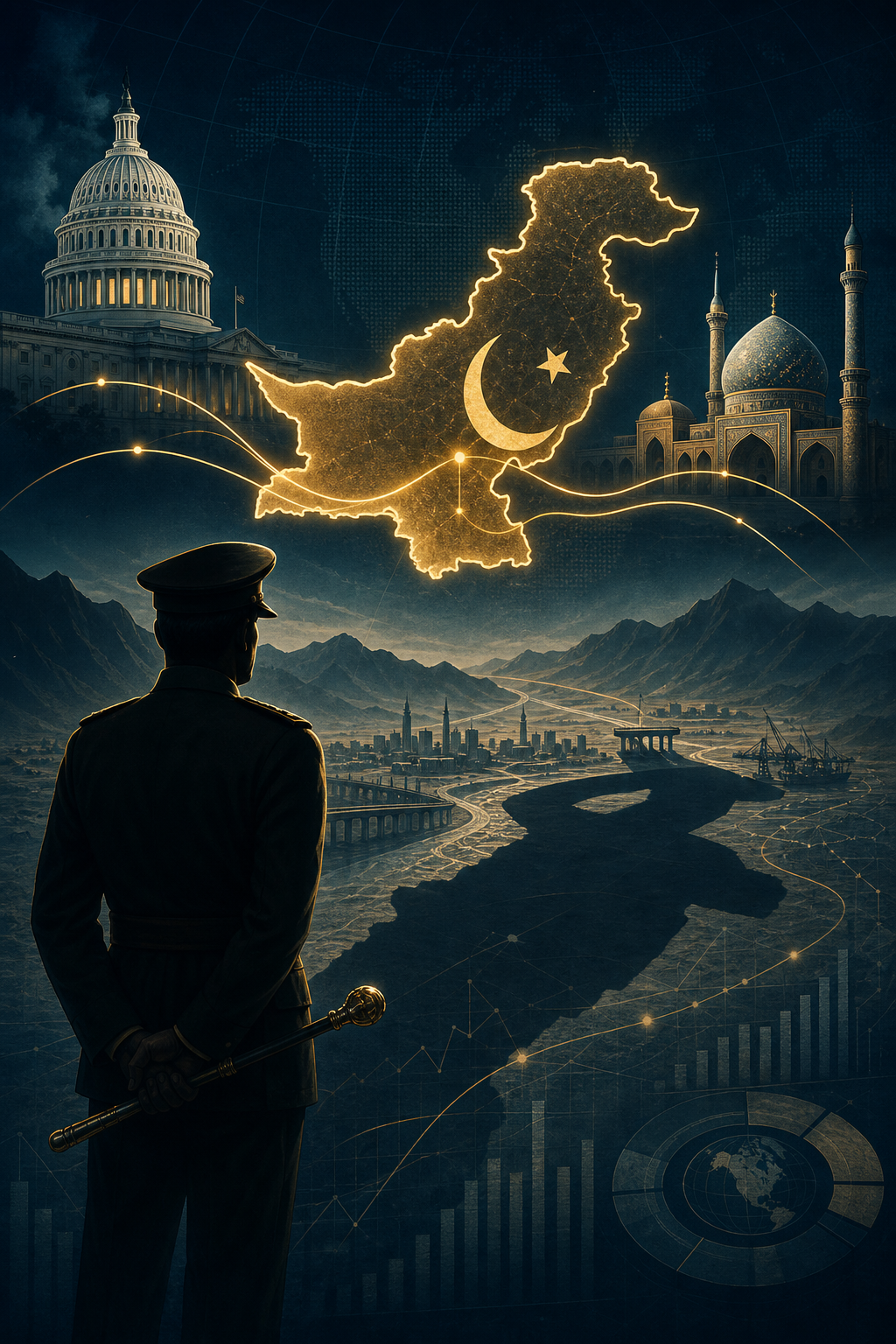
Despite some breathless optimism, the military strongman is unlikely to deliver deeper change.
1. The moment of pride
On April 21st, hours before a ceasefire between America and Iran was due to expire, Donald Trump announced the truce would be extended indefinitely — at Pakistan’s request. For a country long known for IMF bail-outs and insurgencies, it was a startling turn: Pakistan had shown itself a deft handler of global power politics. [1][2]
“I wouldn’t have really been in favour of it, but we did it as a favour to Pakistan, who are terrific people.” — Donald Trump on the ceasefire [3]
At the centre of it all is the man Mr Trump calls his “favourite field marshal.” Throughout the crisis, army chief Asim Munir was on the phone regularly to Mr Trump and vice-president J.D. Vance. The former spy chief spent three days in Tehran — the first high-profile visitor since the bombing stopped — meeting senior political and military leaders. Soon afterwards, Iran said it would open the Strait of Hormuz (only to backtrack in protest at Mr Trump’s blockade). [4][5]
Key figures:
| Metric | Value |
| Days Munir spent in Tehran | 3 |
| Personal visits to Iran | 2 |
| Highest-level US–Iran talks since | 1979 (hosted in Islamabad) |
| Share of Pakistan’s gas imported via Hormuz | ~2/3 |
2. A string of geopolitical wins
Munir’s ascent rests on two wars and one White House relationship. Each crisis burnished his image as the indispensable man — the rare figure trusted in Washington, Tehran and the Gulf capitals simultaneously.
The wins:
- India war (May 2025): A four-day aerial conflict ended in a ceasefire Pakistan credited to Trump’s facilitation; Munir was promoted to field marshal days later. [6]
- US–Iran mediation (Apr 2026): Pakistan brokered the initial 14-day ceasefire and hosted the highest-level US–Iran talks since 1979, including VP J.D. Vance. [2]
- The Trump channel: Two White House visits; Trump called Munir an “exceptional man” and “great warrior.” [7]
- Gulf credibility: Saudi Arabia awarded him the King Abdulaziz Medal (First Class) after a mutual defence treaty in September 2025. [7]
- Image makeover: From “terrorism, instability, economic crisis” to “leading Middle East mediator.” [8]
The limits:
- No permanent deal: Mediation could not turn April’s ceasefire into a lasting end to the conflict or reopen Hormuz. [2]
- Overstating positions: At times Pakistan appeared to misrepresent the sides’ actual stances to push a deal through. [2]
- Abraham Accords pressure: Trump’s demand that Pakistan join the Accords went down badly with a state that has refused to recognise Israel since its founding. [2]
- Self-interest, not altruism: Islamabad genuinely needs the war over — 30–40% of total imports flow through Hormuz, and food and fuel prices are surging. [2]
- Shiite opposition at home: Strong domestic opposition to the US-led war, especially among Pakistan’s large Shiite minority. [2]
3. From general to de facto ruler
The diplomatic wins coincide with — and arguably enable — an unprecedented consolidation of military power at home. Munir’s rise has been rapid, and the constitutional architecture has bent to fit him.
Timeline:
- Nov 2022: Appointed Chief of Army Staff by PM Shehbaz Sharif, after Imran Khan’s ouster in a no-confidence vote. [2]
- May 2025: Elevated to five-star field marshal, 10 days after the four-day war with India — only the second officer in Pakistan’s history to hold the rank after Ayub Khan. [6]
- Sep 2025: Hosted at the White House with PM Sharif; Trump brands him “my favourite field marshal.” [8]
- Nov 2025: 27th Constitutional Amendment — creates the post of Chief of Defence Forces (CDF) held by the army chief, unifying army, navy, air force and the Strategic Plans Division (nuclear). Grants lifetime immunity from prosecution and makes field marshal rank permanent for life. Resets his tenure to a five-year term running to at least Nov 2030. [6][9][10]
- Apr 2026: Centrally brokers US–Iran ceasefire; Trump extends the truce at Munir’s request. [2]
“External validation in this context makes domestic consolidation more dangerous, not less, precisely because it wraps concentration of power in the language of national success.” — analyst, to Al Jazeera [6]
Critics were blunt. The Guardian called the amendment a “funeral for democracy”; Reuters reported warnings of “irreparable harm” to democracy; a constitutional lawyer told Al Jazeera “Democracy does not survive where impunity is made a constitutional right.” [10][11][12]
The practical upshot: the only person who decides how long Munir remains CDF is, effectively, Munir himself. [6]
4. The economy that success masks
For all the geopolitical theatre, Pakistan’s everyday reality is an IMF-stabilised economy that is fragile, not fixed. The diplomatic glow obscures a country still living bailout to bailout.
| Indicator | Value |
| GDP growth, FY26 H1 (yoy) | 3.8% |
| CPI inflation re-entered double digits, Apr–Jun 2026 | 10.9% |
| Policy rate cut by the State Bank | 22% → 12% |
| Energy circular debt | ₨2.6tr |
An IMF Extended Fund Facility has carried Pakistan through six tranche reviews. Headline inflation is back in single digits on paper, the rupee sits in a 280–285 corridor, and reserves are rebuilding. But the war in the Middle East “clouds Pakistan’s near-term outlook,” the IMF warns, putting upward pressure on inflation and the balance of payments. [13][14]
The recovery is already stalling. CPI inflation re-entered double digits (10.9–11.7%) between April and June 2026. A Carnegie analysis notes the country “hit peak stability a year ago… but no reforms came. Nothing happened.” Unemployment and the cost of living remain high, poverty is rising, and rolling blackouts have returned with the global energy crisis. [15][16]
IMF-mandated curbs are squeezing development spending: the federal PSDP has fallen from 2.5% of GDP in FY18 to just 0.6% by 2025–26, leaving roughly ₨11tr in throw-forward liabilities from ~800 unfinished projects. [17]
5. Why deeper change is unlikely
The central tension: Munir’s foreign-policy triumphs buy him legitimacy, but that legitimacy is being spent on entrenching military power — not on reforming the economy or restoring democracy. The two stories point in opposite directions.
What the wins do deliver:
- A seat at the table in Middle East diplomacy and a direct line to the White House. [5]
- Short-term economic breathing room — easing the Hormuz shock that drives inflation. [2]
- A nationalist narrative that flatters the military and crowds out civilian rivals. [6]
What they don’t deliver:
- No structural economic reform — stabilization without growth, per Carnegie. [16]
- No democratic revival — the 27th Amendment weakens the judiciary and enshrines impunity. [10]
- No answer to the past’s lesson: Pakistan’s history is “full of ambitious generals who eventually saw their dreams unravel.” [8]
The verdict
Munir’s geopolitical successes are real but thin — a diplomatic high that, far from presaging deeper change, is being converted into institutional power at home. The stronger his hand abroad, the weaker the checks on him within. Pakistan gains stature; Pakistanis do not yet gain reform.
Geopolitical prestige: high · Prospects for deeper change: low
Sources
[1] How Pakistan managed to get the US and Iran to a ceasefire | US-Israel war… (aljazeera.com)
[2] Pakistan’s suprising role in the Iran war, explained | Vox (vox.com)
[3] A look at how Pakistan and Qatar brokered the US-Iran deal | AP News (apnews.com)
[4] Asim Munir, the Pakistani field marshal negotiating peace between the US a… (english.elpais.com)
[5] Pakistan’s army chief Asim Munir in spotlight after Iran visit | AP News (apnews.com)
[6] India to Iran: How two wars shaped the rise of Pakistan’s Asim Munir | Mil… (aljazeera.com)
[7] Trump’s ‘favourite field marshal’ Asim Munir plays key role in bid to end… (thenationalnews.com)
[8] Who Is Asim Munir, Trump’s ‘Favorite Field Marshal’? – The Diplomat (thediplomat.com)
[9] Pakistan’s army chief gets more powers and lifelong immunity (bbc.com)
[10] Pakistan parliament approves more powers for army chief, curbs top court (reuters.com)
[11] Pakistani parliament votes to give army chief new powers and legal … (theguardian.com)
[12] How would Pakistan’s 27th Amendment reshape its military and courts? | Gov… (aljazeera.com)
[13] Pakistan: Third Review Under the Extended Arrangement Under the Extended F… (imf.org)
[14] Pakistan 2026: The Sharif Coalition, the Military, and the Political Econo… (deluair.com)
[15] Rebounding inflation, fiscal pressures threaten recovery – Newspaper – DAW… (dawn.com)
[16] Pakistan’s Military Consolidation Under Munir Faces Critical … (carnegieendowment.org)
[17] BUDGET 2026-27: IMF-mandated curbs squeeze development spending – Newspape… (dawn.com)