

By : Marco Agnies
Report by : Baloch Voice Association Full Report PDF
Geneva, Switzerland — 4 August 2026 — The Baloch Voice Association (BVA), an NGO based in Paris and accredited for advocacy at the United Nations, today publishes a detailed report on the conflict in Balochistan, the human rights situation in the province, and the longstanding demands of the Baloch people. The report is released ahead of the 63rd Session of the United Nations Human Rights Council (HRC63), which will take place at the Palais des Nations in Geneva from 7 September to 9 October 2026, and is intended to inform the deliberations of Council members, special rapporteurs, and the wider international community.
The report, titled « The Conflict in Balochistan: A Detailed Report on the Crisis, Human Rights, Enforced Disappearances, and the Suppression of Dissent, » brings together documentation from the Human Rights Commission of Pakistan (HRCP), the UN human rights apparatus and the Working Group on Enforced or Involuntary Disappearances, Amnesty International, Human Rights Watch, the Voice for Baloch Missing Persons, and the Human Rights Council of Balochistan, alongside academic and journalistic sources.
Key Findings of the Report
1. A « Grave » and Worsening Human Rights Crisis
In August 2025, the Human Rights Commission of Pakistan (HRCP) warned of a « grave » human rights crisis in Balochistan, after a fact-finding mission uncovered « a disturbing pattern of continued enforced disappearances, shrinking civic space, erosion of provincial autonomy, and unchecked impunity. » The HRCP observed that while state representatives now acknowledge the existence of enforced disappearances, they do so within a security narrative that treated the practice as a byproduct of insurgency — a framing that « risked normalising what international human rights law considers a crime against humanity. »
2. The Scale of Enforced Disappearances
The report documents the alarming scale of enforced disappearances. The Commission of Inquiry on Enforced Disappearances (COIED) has recorded at least 10,078 enforced disappearances nationwide since 2011, of which 2,752 took place in Balochistan. Human rights organisations and families in Balochistan suggest much higher numbers, with one detailed list compiled by a Voice for Baloch Missing Persons organiser recording 18,000 missing persons from the province since 2001, and records of 1,500 bodies that were dumped.
In the first six months of 2025 alone, Paank documented 785 enforced disappearances and 121 killings. The UN Working Group on Enforced or Involuntary Disappearances has noted that « between 2017 and 2024, there have been hundreds of reports of enforced disappearances in Balochistan of journalists, human rights defenders, students. »
3. A Detailed List of the Disappeared
The report includes a detailed, named list of individuals subjected to enforced disappearance — including Dr. Deen Muhammad Baloch (abducted 28 June 2009), Zahid Baloch (abducted 18 March 2014), Bashir Azeem (disappeared three times — 2005, 2006, and 2009), and dozens of recent cases from 2021 to 2025, including students as young as 15. The report notes that Pakistan’s forces « are faster abducting innocent Baloch people than us listing them, » so any list is necessarily incomplete.
4. The Imprisonment of Human Rights Defenders and Journalists
The report documents the criminalisation of peaceful protest and the imprisonment of human rights defenders. Dr. Mahrang Baloch, central organiser of the Baloch Yakjehti Committee (BYC), was arrested in March 2025 and charged with over two dozen anti-terrorism cases. On 22 June 2026, an anti-terrorism court in Quetta sentenced her and fellow activist Sibghatullah Shah to life imprisonment following a trial that Amnesty International described as conducted largely in secret. UN human rights experts have demanded the release of Dr. Baloch and other detained BYC leaders, expressing « serious alarm at the detention of individuals for merely exercising their right to peaceful assembly. »
Multiple journalists — including Niaz Baloch, charged with terrorism for posting a speech by Dr. Mahrang Baloch; Maqbool Jaffar, arrested under the Prevention of Electronic Crimes Act (PECA); and Sarfaraz Shah, detained reportedly for failing to submit a tenancy form — are documented in the report.
5. The Collapse of Freedom of Expression and Assembly
A December 2025 report by media watchdog Freedom Network concluded that « journalism is lost in Balochistan, » with enforced and self-censorship now « widespread survival strategies. » Over two decades, 40 journalists have been killed in Balochistan, roughly 30 of them target-killed. Pakistan’s ranking in the Press Freedom Index declined from 152nd to 158th place. The right to peaceful assembly has been severely curtailed, with blanket bans on assemblies and protests routinely met with live bullets, tear gas, and mass arrests.
6. Economic Exploitation and the Strategic Importance of Balochistan
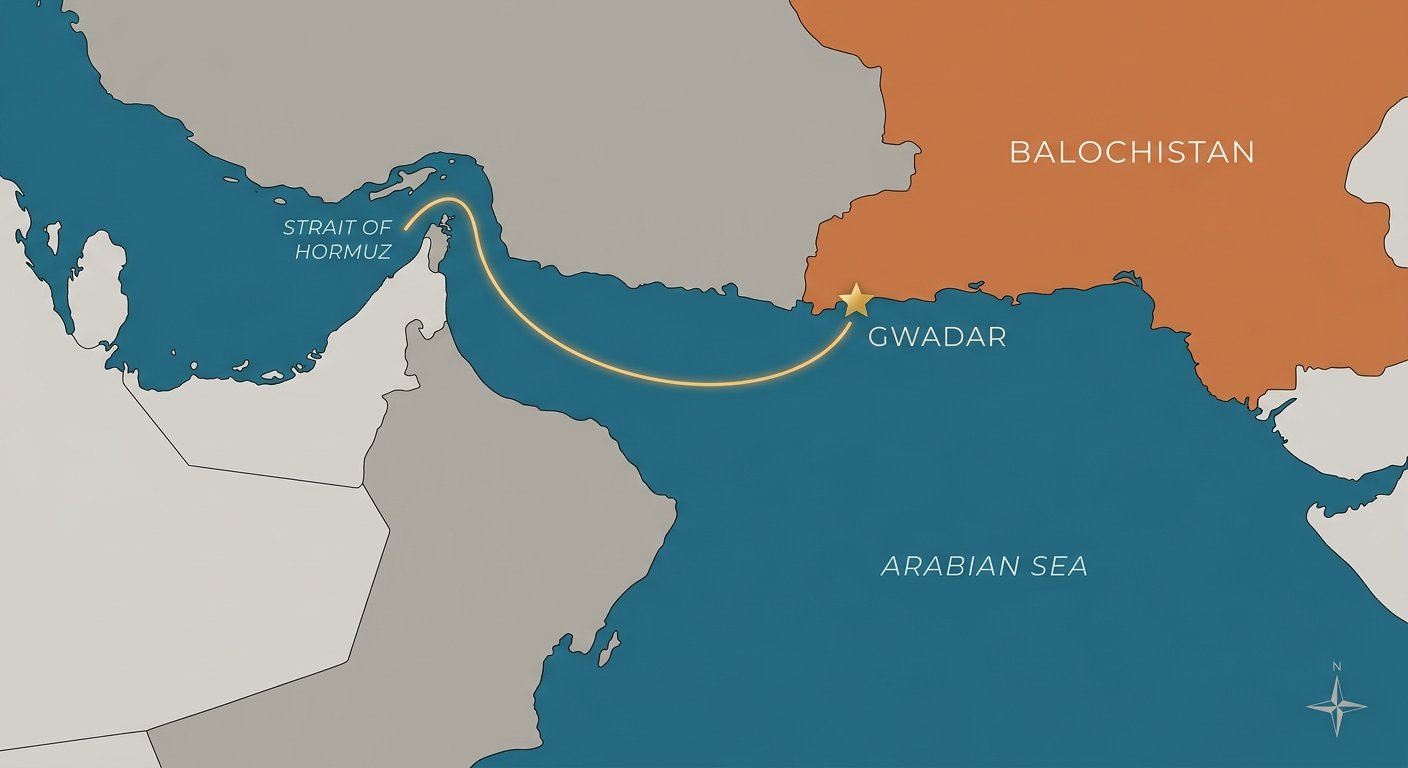
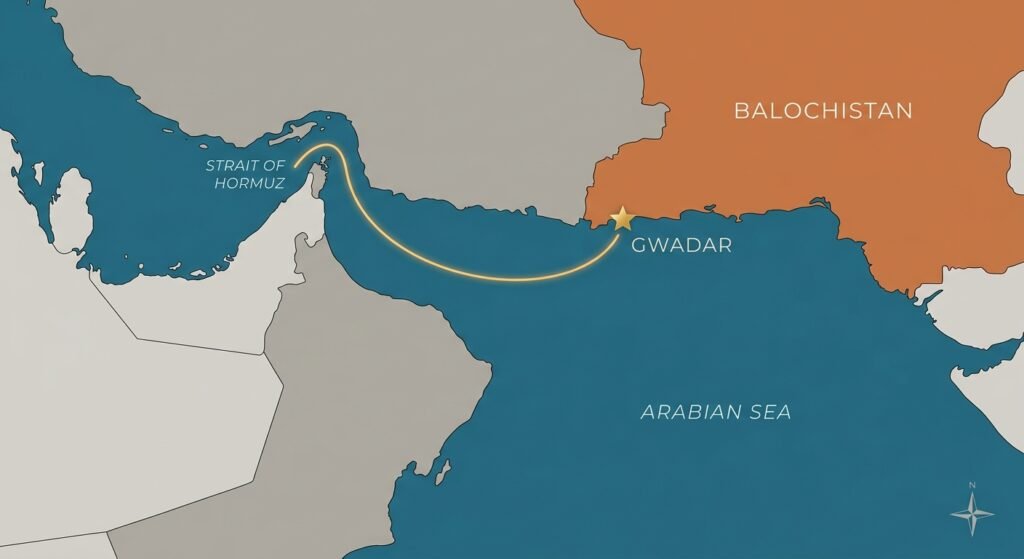
Despite sitting atop enormous natural wealth — oil, coal, gold, copper, and vast gas reserves — Balochistan remains Pakistan’s most impoverished province. The China-Pakistan Economic Corridor (CPEC), a roughly $60 billion infrastructure initiative, has sharpened grievances. Gwadar, Pakistan’s only deep-sea port and a key CPEC node, has become a focal point of anger, with local communities reporting restricted access to fishing waters, land grabbing, militarisation, and ecological destruction. The report includes a strategic map illustrating Gwadar’s sea route to the Strait of Hormuz, underscoring Balochistan’s position at the vital crossroads of South Asia, the Middle East, and Central Asia.
7. Pakistan’s Repeated Betrayals and the Demand for Independence
The report documents a pattern of broken promises stretching from 1948 to the present — from the forced accession of Kalat in 1948, to the immediately broken amnesty to Prince Abdul Karim, to the betrayal of Nauroz Khan in 1959, to the dissolution of the elected Baloch government in 1973. Given this record, Baloch leaders maintain that dialogue with Pakistan alone, without an external guarantor, would only produce another broken promise.
The report documents that Baloch leaders have repeatedly and explicitly stated that the goal is the restoration of sovereignty and independence:
- His Highness Mir Suleman Dawood Jan Ahmedzai, the 35th Khan of Kalat, has formally approached the United Nations demanding a referendum in Balochistan, stating: « We do not want to be a Part of Pakistan anymore and request the United Nations to conduct free and fair process of referendum in Balochistan under guidelines and supervision of the United Nations. »
- Hyrbyair Marri, head of the Free Balochistan Movement, has stated: « We are demanding the restoration of our sovereignty… We just want independence, which is a basic human right. »
- Professor Naela Quadri Baloch, Prime Minister of the Government of Balochistan in Exile, has stated that « Balochistan, which was once an independent country, is under the illegal occupation of Pakistan. »
- Mehran Marri has stated that « we have the right to live as a free nation. »
- Siddique Azad Baloch, Secretary General of the Baloch Peoples Congress, has called upon the international community to take urgent notice of abuses and has framed the Baloch struggle as one for national liberation and sovereignty.
Recommendations of the Report
The report calls upon the international community, through the United Nations, to:
- Dispatch special rapporteurs and fact-finding missions to Balochistan to independently document the human rights situation, including enforced disappearances, extrajudicial killings, and the suppression of dissent.
- Hold Pakistan accountable for violations of international human rights and humanitarian law, including the crime against humanity of enforced disappearance.
- Facilitate and mediate a structured dialogue between genuine representatives of the Baloch people and the state of Pakistan, under international supervision, to reach a binding agreement with external guarantees.
- Arrange for the Baloch people to exercise their right to self-determination through a free and fair referendum or comparable process conducted under the supervision and guidelines of the United Nations.
- Pressure Pakistan to immediately release Dr. Mahrang Baloch, Sibghatullah Shah, and all detained human rights defenders, journalists, and peaceful activists.