

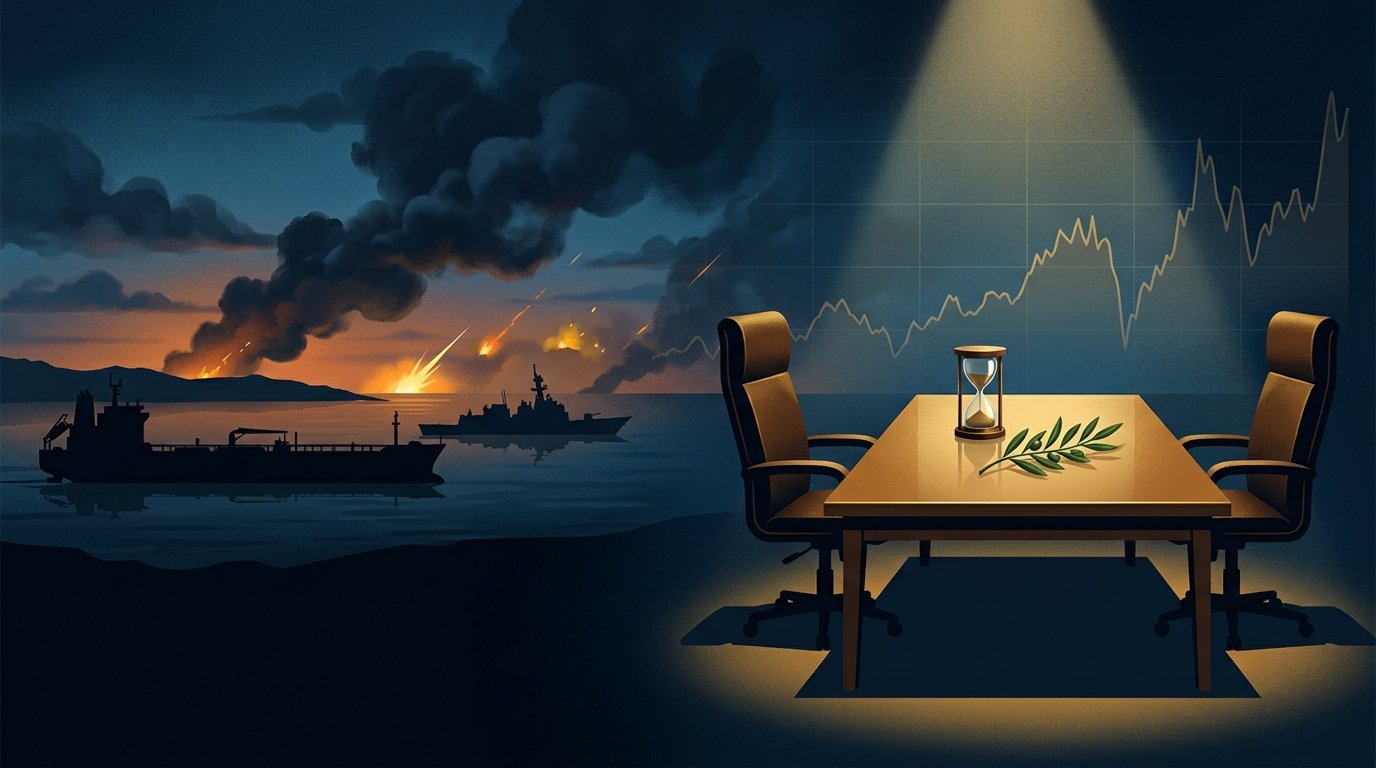
A five-month conflict has redrawn the map of the Middle East, choked the world’s most important oil corridor, and left two adversaries trading strikes even as they trade words. Here is where things stand.
How the War Began
The United States and Iran are now in the fifth month of a war that erupted on February 28, 2026, when the US and Israel launched coordinated airstrikes on Iran. The opening bombardment killed Supreme Leader Ayatollah Ali Khamenei along with dozens of other officials, and triggered a wider conflagration across the Middle East. Power in Tehran passed to a new Supreme Leader, Ayatollah Mojtaba Khamenei, under whom the Islamic Republic has adopted a markedly harder line toward Washington.
From the first day, Iran’s leadership framed the conflict in terms of revenge. Ali Larijani, a top security official, warned that Tehran would not « leave Trump alone » for the killing of Khamenei. The US president at the time dismissed the threat, saying he did not know Larijani and « couldn’t care less ».
A Whiplash Ceasefire
The two sides have lurched between war and diplomacy ever since. A first ceasefire took hold on April 8, but quickly deteriorated. In mid-June, negotiators reached a 14-point Memorandum of Understanding (MOU) brokered by Pakistan, Qatar, and other regional countries, covering the reopening of the Strait of Hormuz, easing of financial strain on Iran, and a plan to address Tehran’s nuclear programme. The US lifted its naval blockade, and the two sides held direct talks at the Swiss resort of Burgenstock on June 21–22, producing a roadmap for peace.
The truce did not hold. On June 25, Iran struck a ship in the Strait of Hormuz — interpreted by Washington as the first violation of the MOU. The US responded with strikes on Iranian missile, drone, and radar sites. Iran then attacked a tanker, and Washington struck again; Iran lashed out at Kuwait and Bahrain, both of which host American troops.
By July 8, President Donald Trump declared the ceasefire « over » — though he said negotiations could continue. The US military struck over 140 targets in Iran after an Iranian attack on a container ship left a crew member missing; later waves hit more than 170 targets, including air defence systems and Revolutionary Guard vessels. Iran’s Health Ministry said at least 14 people were killed and 78 wounded in the US strikes.
Iran’s lead negotiator declared: « The era of bullying and extortion is over. »
The Strait of Hormuz: Chokepoint of the World Economy
At the heart of the conflict is the Strait of Hormuz, the narrow waterway that normally carries about a fifth of the world’s crude oil and liquefied natural gas. Iran’s Islamic Revolutionary Guard Corps closed the strait after the ceasefire collapse, while Washington maintains a blockade of Iranian shipping and ports.
The economic toll has been staggering. Amin Nasser, chief executive of Saudi Aramco, said on August 4:
« Current trade flows through the Strait of Hormuz are at a tenth of pre-conflict levels and the world will continue to lose more than 100 million barrels for each week the strait is closed. »
Nasser added that the world has already lost more than 2.6 billion barrels of oil destined for critical industries, that an average of 11 million barrels per day of liquids supply had been removed, and that Asia’s crude oil imports fell by around 6 million barrels per day at the peak of the crisis. Aramco has rerouted crude around the strait via its East-West pipeline.
Oil markets have swung violently with each twist. After Trump signalled a possible deal on August 3, Brent crude fell about 7% to a three-week low near $83 a barrel. A day later, after a cargo vessel was struck near the strait and Iran denied any talks were under way, prices rebounded nearly 3%.
« The market can quickly price in the possibility of a deal, as the August 3 selloff showed, but it can reverse just as quickly if talks collapse, shipping is attacked or Hormuz remains effectively restricted. »— Tim Waterer, chief market analyst at KCM Trade
« We Are Talking Right Now » — Or Are They?
The diplomatic picture is clouded by sharply contradictory accounts. On August 3, Trump told reporters at the White House that talks with Iran were « going on right now, » calling it Tehran’s « last chance before decapitation » to sign a deal. He said he had agreed to pursue talks at the request of Saudi Arabia, the UAE, Qatar, and Iran itself, and predicted the strait would be « completely open » by Tuesday.
« This is a last chance. This is not something that if it doesn’t happen, this is a last chance for them to sign a good document. »— US President Donald Trump
Iran flatly denied it. Foreign Ministry spokesman Esmaeil Baghaei said no negotiations with the United States were taking place and none were scheduled, and that Iran had no plans to host foreign delegations or send negotiators abroad.
« Our negotiations are with Oman to secure passage through the Strait of Hormuz. »— Iranian Foreign Ministry spokesman Esmaeil Baghaei
Baghaei added that the US had « violated all of its commitments » in June when the ceasefire fell apart. Later, on Truth Social, Trump called Iran’s leadership « unbelievably duplicitous, » insisting they had asked for a meeting and that more talks were scheduled.
The reality, analysts say, sits between the two accounts. Iran can maintain that it is not negotiating directly while messages move through intermediaries — chiefly Oman, but also Qatar and Pakistan — while Trump can claim negotiations are under way because Washington is involved indirectly. The two sides have not held direct talks since the Burgenstock meeting in mid-June.
Two Leaders, Two Messages
In Tehran, the message remains one of defiance. Supreme Leader Mojtaba Khamenei said the United States and Israel had been dealt a « decisive blow » and were now « experiencing a deeply meaningful and profound humiliation ». Iran’s Assembly of Experts warned that « trusting this hegemonic government is nothing but a mirage » and that « hope for understanding and agreement with this bullying regime will lead nowhere ».
The military command has been even blunter. Major General Ali Abdollahi, head of Iran’s wartime military command, said:
« The United States is moving at an accelerating pace to fan the flames of a full-scale regional war… any country that makes itself a defensive shield for criminal, aggressor America will burn in the fire of war. »— Major General Ali Abdollahi
Mohsen Rezaei, a military adviser to the Supreme Leader, warned that Iran’s armed forces « will not stand idly by » and allow the naval blockade to continue — and that US warships attempting to establish an alternative corridor through the strait could become targets.
What Happens Next
Trump has said he has no time constraints on the negotiations, noting he is not seeking re-election in November’s midterms. He outlined a two-phase process: first, reopening the Strait of Hormuz; second, addressing Iran’s nuclear programme. Yet he has yet to achieve the objectives he set at the outset of the war — dismantling Iran’s nuclear programme, curbing its ability to attack regional rivals, and creating conditions for Iranians to change their government.
For now, the strait remains the world’s biggest wildcard. A CBS News report citing US officials said there are no new or extraordinary negotiation plans — only the continuation of existing consultations via mediators. Until the waterway is demonstrably safe and open to sustained commercial traffic, any decline in oil prices — and any optimism about peace — remains vulnerable to another geopolitical shock.
The war and the dialogue are running on parallel tracks. Both, for now, show no sign of ending.