

The road to economic serfdom — and the limits of trying to legislate your way to sovereignty
By Staff Correspondent | August 2026
It did not take long after blue jeans, Hollywood blockbusters and Big Macs crossed the Atlantic last century for worrywarts to start fretting about Europe falling prey to American dominance. What was once a diffuse concern about cultural hegemony has, in recent years, morphed into something far more acute: panic over commercial dependency. With some justification. The commanding heights of the modern European economy have quietly been captured by American firms.
Apple and Google power the mobile phones used from Dublin to Dubrovnik. Silicon Valley titans have spawned the cloud computers that store Europeans’ data, and from which American artificial-intelligence models are now being deployed deep inside the continent’s businesses. Visa and MasterCard, two American firms, are often required for Europeans to pay other Europeans. Increasingly the continent’s lights are kept on by American liquefied natural gas, replacing an erstwhile reliance on Russian energy .
A dependency made in Brussels
This form of economic vassalage, which comes on top of dependence on the United States for security, is hardly new. « Why can’t Europe build its own Google? » has long been a predictable lament at Brussels conferences. What has changed is the geopolitical stakes. In an age when such entanglements can be weaponised — not least by Donald Trump and his MAGA faction in America — the question is no longer merely commercial. It is strategic.
The numbers underline how deep the dependency runs. Amazon, Google and Microsoft together provide roughly 70 percent of Europe’s cloud infrastructure. A report by the Future of Technology Institute (FOTI) found that about three-quarters of listed European firms rely on American technology. Reliance is highest in Iceland, Norway, Ireland, Finland and Sweden, where more than 90 percent of firms use American cloud providers. Britain’s competition authority has found that Microsoft and Amazon Web Services control 60 to 80 percent of the UK cloud market. Europe has few homegrown providers — OVHCloud, SAP and Deutsche Telekom are the exceptions, not the rule .
The software bill tells the story in euros and cents. Germany’s federal government pays almost half a billion euros a year in licence fees to Microsoft alone. A French business association estimates that large French companies buy more than $50 billion in software and cloud services annually from America’s tech giants. Euro-zone imports of intellectual-property services from the United States have ballooned to roughly $200 billion a year and counting . Around 80 percent of EU enterprise-software spending goes to American firms, with Microsoft, Oracle, Salesforce and IBM dominating .
The regulation paradox
The cruel irony is that Europe’s dependency is, in significant part, self-inflicted. For two decades the European Union has styled itself as the world’s « regulatory superpower » — a referee of the digital economy rather than a player in it. The EU has come to be perceived as a regulator of digital markets rather than a successful, active competitor .
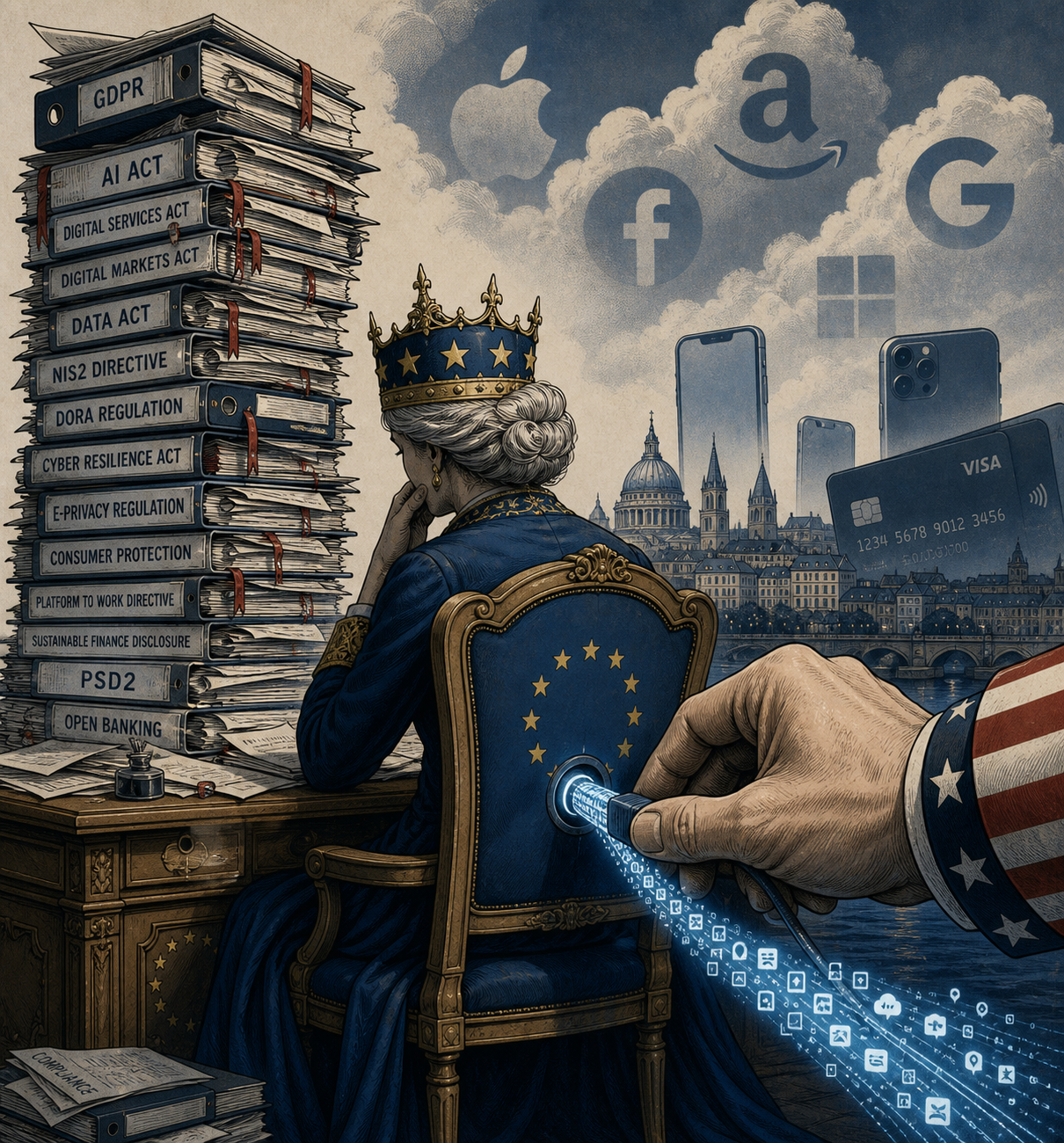
The roll-call of rulebooks is long: the General Data Protection Regulation (GDPR), the Digital Markets Act (DMA), the Digital Services Act (DSA), the Data Act and the Artificial Intelligence Act (AI Act). Each was designed to protect citizens, promote competition and enshrine European values in the digital age. But critics — including some of Europe’s own industrial champions — argue the cumulative effect has been to hobble domestic innovators before they can scale, while doing little to curb the dominance of the American giants the rules were meant to constrain .
The warnings have grown louder. In May 2026 Christophe Fouquet, the chief executive of ASML — Europe’s most important technology company — warned that Brussels was driving AI companies away. He pointed in particular to the AI Act as an example of the bloc setting boundaries before European companies had built strong products of their own. ASML was joined by Airbus, Ericsson, Mistral, Nokia, SAP and Siemens in warning Commission President Ursula von der Leyen that the legislation risks crippling European companies before they can compete with American and Chinese rivals .
The data bear out the concern. Nearly 60 percent of small European tech companies surveyed reported delays in product development due to regulations, compared with 44 percent of small American companies, according to reports shared in late 2025. The United States has no expansive federal AI law comparable to the EU’s AI Act, which polices general-purpose AI and its risks. American startups, facing fewer barriers, speed ahead . European consumers, meanwhile, routinely wait months longer than Americans for new tech products — and often receive them with features missing, a consequence of privacy rules, the DMA and cautious corporate rollouts .
The core problem, many argue, is fragmentation. « We cannot regulate our way to success, » says Cecilia Bonefeld-Dahl of DigitalEurope. The bloc’s 27 member states each buy in their own small box. There is no scalable demand, and only about 8 percent of European companies trade across even a single border. For technology companies, that fragmentation hampers the ability to scale across the continent — a structural disadvantage the United States and China simply do not face .
The weaponisation problem
If the commercial costs of dependency are familiar, the geopolitical risks are newer and more alarming. European officials increasingly worry that Mr. Trump, who has already exploited trade and defence dependencies, may weaponise technology next — threatening to disrupt or cut off digital services to extract concessions. None of the researchers, officials and experts who have discussed the matter publicly deem that possibility far-fetched .
The scenarios are uncomfortable to contemplate. If Mr. Trump really wants Greenland, could he threaten to cut off Europeans’ ability to pay in shops, or switch off their iPhones en masse? Could some perceived slight from the German chancellor result in the Mittelstand being shunted off cutting-edge AI models, hobbling their prospects? The possibilities seem, alas, endless .
Central to the anxiety is the American CLOUD Act, which requires United States-based providers to grant authorities access to data even when it is stored abroad. For European governments, that means data hosted by American cloud firms is never quite beyond Washington’s reach — a « kill switch » that the Trump administration or future presidents could in principle exploit to block access to essential services . The quiet consensus in Brussels is that Europeans cannot abide an American president having his finger on such a switch .
A course correction, late and uneven
Belatedly, Europe is trying to reverse course. In June 2026 the European Commission proposed the Cloud and AI Development Act and a Chips Act 2.0, part of a « made-in-Europe » drive to cut reliance on American Big Tech. The Commission wants to double the EU’s global market share of semiconductors to 20 percent by 2030. For critical public contracts in sectors such as banking, energy and healthcare, vendors will be required to ensure software and hardware are made in the EU, excluding non-European countries from controlling data and services .
A « Digital Omnibus » package presented in late 2025 aims to simplify obligations across GDPR, the AI Act and the Data Act, and the Commission has already delayed some AI Act obligations for high-risk systems in response to industry pressure . There are flickers of commercial promise too: Mistral AI reportedly saw revenues surge as a European alternative to OpenAI, and in 2026 simply not being American — nor Chinese or Russian — is increasingly a selling point .
Yet the steps taken so far are uneven and often reactive, the painful realisation that dependency comes with strings attached arriving only after the strings were already tied. Building a « EuroStack » to rival America’s will require more than procurement preferences and semiconductor targets. It will require the single market in digital services that Europe has spent two decades failing to build — and a willingness to treat innovation as something more than a regulatory nuisance to be managed.
The road ahead
Europe’s predicament is not that it regulated. It is that it regulated in lieu of building. The GDPR, the DMA and the AI Act were each, in their way, reasonable responses to real harms. But they were never matched by a comparable effort to create the homegrown champions that might one day make such rules redundant. The result is the worst of both worlds: a continent that is heavily dependent on American technology and increasingly anxious about it, yet which has spent twenty years erecting guardrails around industries it never quite managed to grow.
The road to economic serfdom, it turns out, was paved with good intentions — and a great deal of red tape. Whether Europe can now pave a different one, in an age of weaponised interdependence, is the defining economic question of the continent’s decade.
This article draws on reporting from The Economist, Reuters, the Carnegie Endowment for International Peace, Foreign Policy, Politico, The New York Times, TechCrunch, Semafor, Euronews, Bruegel and EU Perspectives.