

Rebecca Blackwell/AP
Commentary on the human cost of America’s immigration enforcement regime
The most revealing stories of a nation’s character are rarely the ones shouted from podiums. They are the ones told in whispers, behind closed doors, by parents who cannot sleep. A CNN report this week laid bare one such story: across the United States, immigrant families are making preparations once unthinkable in a country that has long styled itself as a refuge — naming guardians for their children, staying home from work and worship, and in one wrenching case, a mother considering giving up her unborn child for adoption so that the baby might have a future she feared would be denied.
These are not abstract policy debates. They are the lived consequences of a years-long escalation in immigration enforcement and political rhetoric that has cast a shadow of fear over entire communities.
We should say plainly what this reporting confirms: the human toll of our current approach is real, it is widening, and it falls most heavily on people who have spent decades building lives, families, businesses and congregations in the United States.
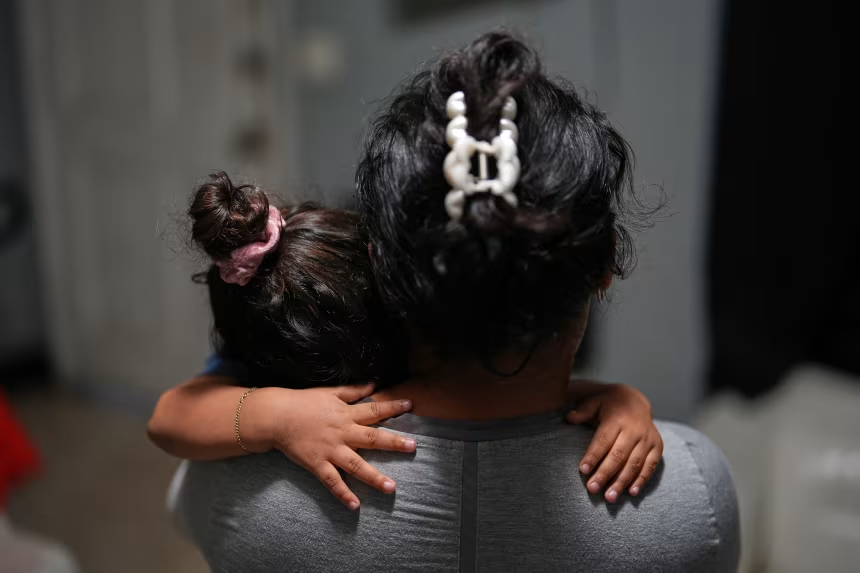
Consider the families at the center of this reporting. A Salvadoran mother in Maryland signed legal papers naming her parish priest as temporary guardian of her 7-year-old son, in case she and her husband are deported. At one church in Hyattsville, a priest has been named standby guardian for at least 31 children. More than 100 U.S.-citizen children — from newborns to teenagers — were found by a CNN investigation to have been left without their parents after immigration enforcement actions, some taken in by neighbors, others entering foster care. These are American children, by birth and by every measure of belonging, absorbing the disruption of policies aimed at their parents.
The fear has reshaped daily life in ways that extend far beyond those directly at risk. Pastors in Chicago describe congregations too afraid to buy groceries. Once-bustling shops and restaurants in Minneapolis and New Orleans have gone quiet during enforcement operations. In Brooklyn’s Little Haiti, streets and businesses emptied after the administration ended Temporary Protected Status for Haitians. Community leaders warn of ripple effects in hospitals, nursing homes and home health care — sectors where many of these same immigrants work, and which the rest of the country depends upon.
There is a bitter irony here. The very communities being driven into the shadows are the ones staffing the care economy that allows the rest of society to function. The cost of this fear is not borne by immigrants alone.
Some families have chosen to leave before being forced to. A couple in Minnesota, both brought to the U.S. as small children and protected under DACA, sold their home, vehicles and belongings and departed for Mexico — a country one of them said she knew nothing about, where « everything I know is Minnesota. » An undocumented man in Pittsburgh prepared to move to Mexico with his American wife and their three U.S.-born children rather than risk being separated by detention. These departures are presented as voluntary. But a choice made under the weight of fear is not truly free, and we should be honest enough to say so.
The Supreme Court’s June 30 ruling affirming that the 14th Amendment guarantees birthright citizenship was a necessary corrective — and for mothers like Emma Confesor, who had spent her pregnancy agonizing over whether her child would be recognized as American, it came as a relief that was itself an indictment of how much fear had been allowed to accumulate. No expectant mother should have to consider inducing labor early, or giving up her child, to secure what the Constitution already promises.
The temptation, as always, is to treat these stories as isolated anecdotes. They are not. They are the visible edge of a policy environment in which the understandable goal of enforcing immigration law has metastasized into a climate of pervasive dread — one that reaches into schools, churches, hospitals and homes, and that touches citizens and noncitizens alike.
This is not a call for open borders, nor a denial that any sovereign nation has the right to set and enforce immigration policy. It is a call for proportion, for decency, and for a reckoning with what we are willing to accept in the name of enforcement. A country that drives parents to plan for their own disappearance, that empties its own neighborhoods and silences its own congregations, that makes orphans of its own citizens’ children in the pursuit of their parents, is not merely enforcing its laws. It is diminishing itself.
The families in this reporting are not asking for extraordinary privilege. They are asking to live without the constant dread of being torn apart — to work, to worship, to raise their children, to buy groceries. The fact that these have become acts of courage is a failure of policy, not of the people living under it.
We can, and should, do better. The first step is simply to see what is happening — not as a political abstraction, but as the quiet upheaval it is, unfolding in homes and churches and schools across the country. The second is to insist that any immigration policy worthy of this nation measure its success not only by how many people it removes, but by how much unnecessary suffering it avoids.
The measure of a country is not only whom it welcomes, but how it treats those who have already made their lives within it. On that measure, this moment is failing — and the people paying the price are the ones least able to refuse it.