
GENEVA POLICY FORUM
Independent Analysis · Geneva
Policy Brief No. GPF/SUD/2026-04 · September 2026 · Geneva, Switzerland · 12 min read

Sudan Chemical Water: The Weaponisation of a Lifeline
As chemical weapons allegations against the Sudanese Armed Forces multiply, a parallel and equally devastating crisis is unfolding: the diversion of chlorine meant for water purification into munitions, and the contamination of water sources in a country where 17 million people already lack safe drinking water. This brief examines the nexus between chemical weapons use and the collapse of water security in Sudan, and sets out recommendations for the international community.
Published by Geneva Policy Forum · Authors: GPF Research Unit · Geneva, Switzerland
Executive Summary
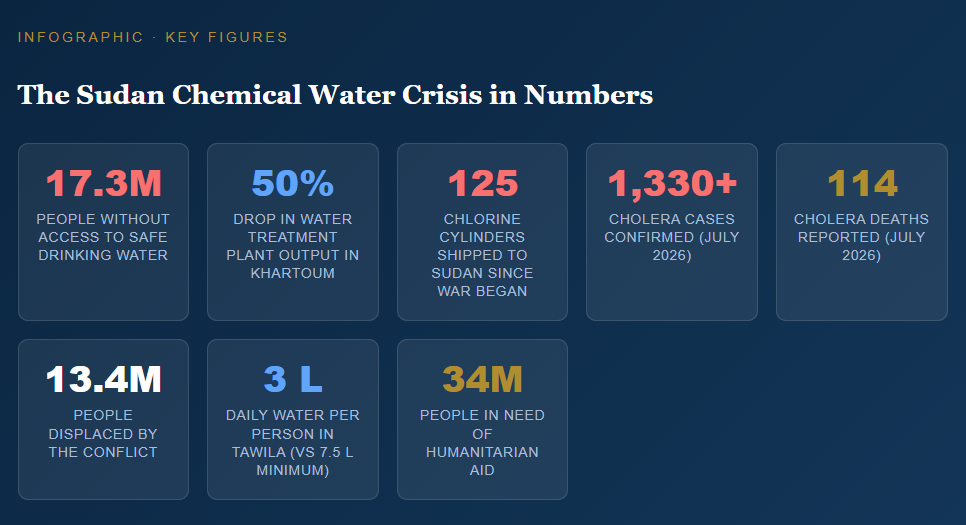
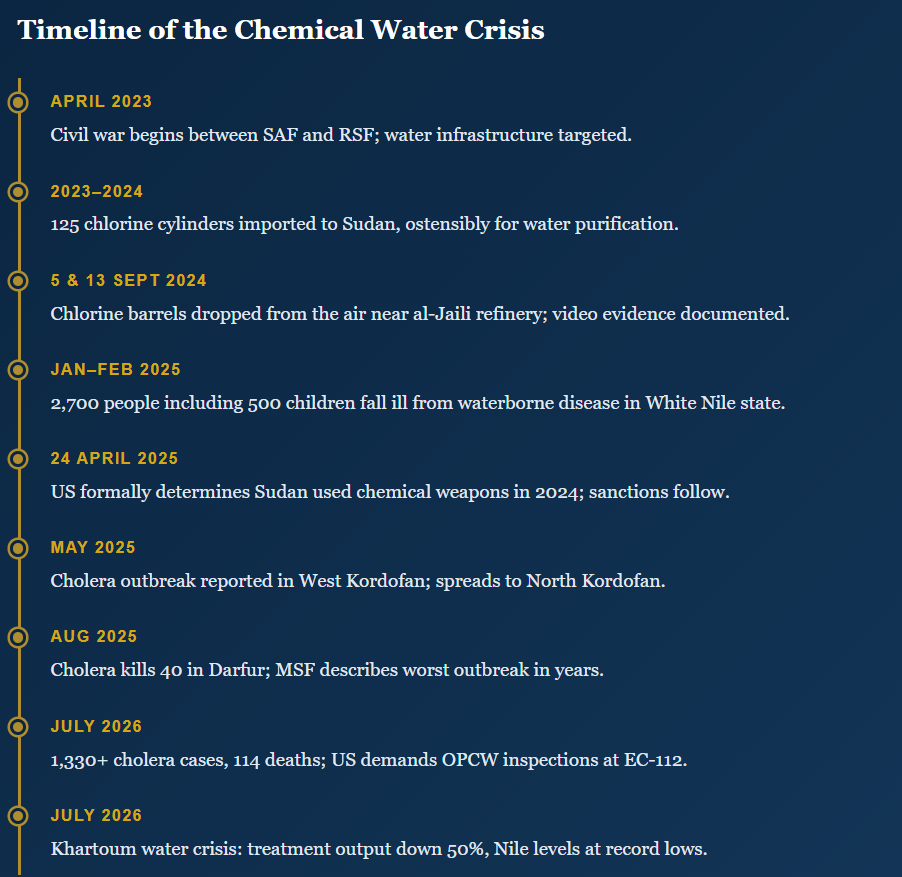
The civil war in Sudan, which began in April 2023 between the Sudanese Armed Forces (SAF), has produced what the World Health Organization calls the world’s largest humanitarian crisis, with 34 million people in need of aid and 21 million lacking health services. [9]
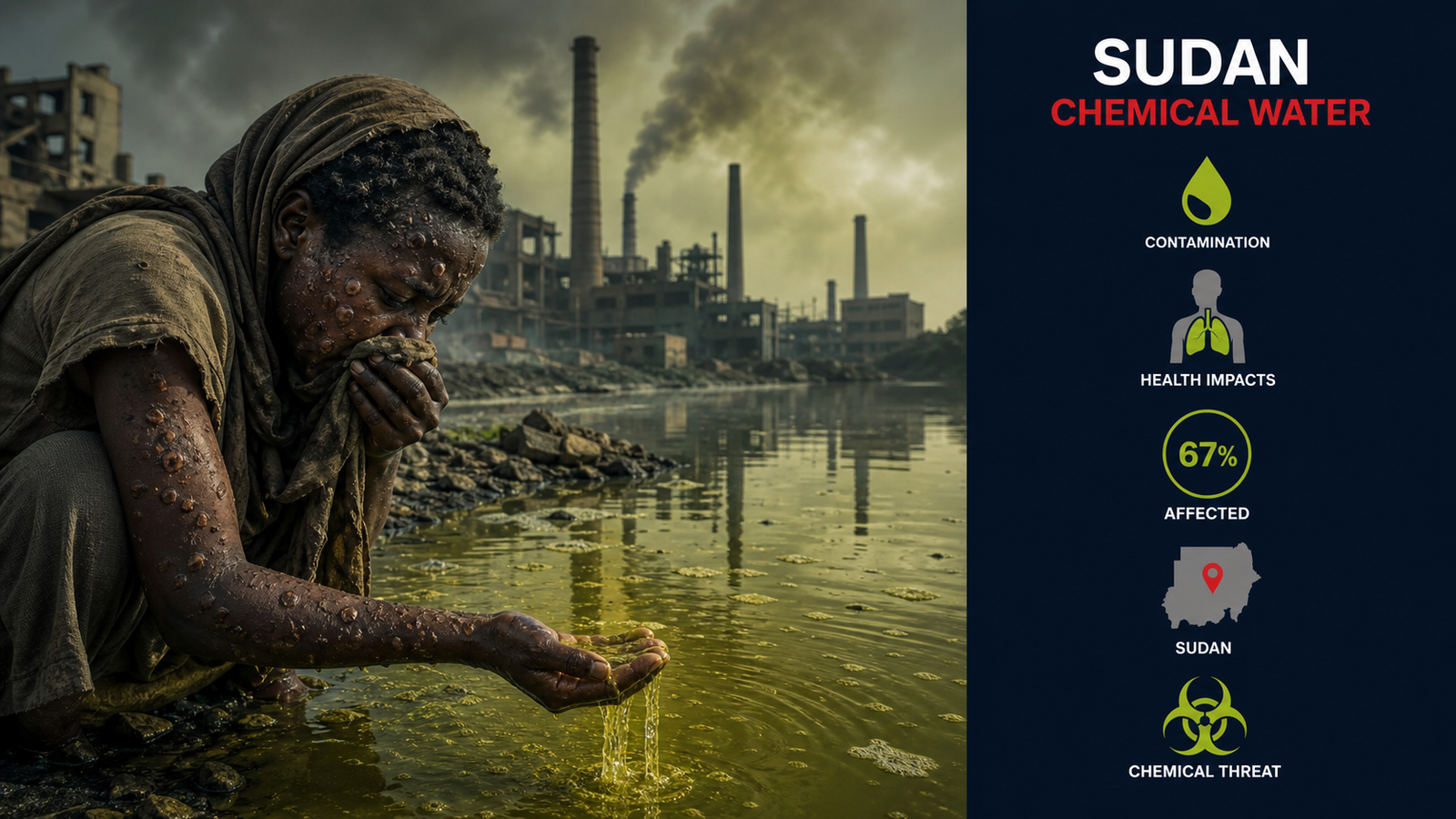
This Geneva Policy Forum brief finds that the chemical weapons programme and the water security crisis in Sudan are not separate phenomena — they are intimately linked. The same chlorine that could have purified drinking water for millions was instead allegedly weaponised. Meanwhile, the destruction of water treatment infrastructure, the contamination of water sources, and the resulting outbreaks of cholera and other waterborne diseases represent a public health emergency that demands urgent international attention alongside the accountability agenda for chemical weapons use.
Sources: France 24, WHO, UN News, MSF. [1][8][9][10]
Key Findings
• Chlorine diversion: An investigation by France 24 traced at least 125 chlorine gas cylinders shipped to Sudan by the Indian company Chemtrade International Corporation since the war began, ostensibly for water purification. At least two were allegedly dropped as weapons near the al-Jaili refinery in September 2024. [1][2]
• Chemical weapons use confirmed by the US: The United States formally determined in April 2025 that the Government of Sudan used chemical weapons in 2024, finding continued non-compliance in 2025 under the Chemical Weapons Convention (CWC), which Sudan ratified in 1999. [6][19]
• Water infrastructure collapse: In Khartoum, declining Nile water levels have forced water treatment plants to cease operations, with output at functioning plants falling by approximately 50%. Entire neighbourhoods are without running water. [11]
• Disease outbreaks: A cholera outbreak in July 2026 claimed over 114 lives and infected more than 1,330 people across Darfur and Kordofan. Malaria, dengue, measles, hepatitis E, and meningitis are also spreading. [8][9]
• Accountability gap: Sudan’s internal technical committee — which included the alleged architect of the chemical weapons programme — concluded there was « no evidence of chemical or radioactive contamination, » a finding the US rejected as no substitute for independent OPCW verification. [6][7]
The Chlorine Paradox: From Water Purification to Weapon
Perhaps the most disturbing dimension of the Sudan chemical weapons crisis is its origin in a civilian water supply chain. Chlorine is one of the most common and essential chemicals used globally for water purification — a critical need in Sudan, where an estimated 17.3 million people lack access to safe drinking water. [1][4]
According to the France 24 Observers investigation, the Indian company Chemtrade International Corporation exported at least 125 chlorine gas cylinders to Sudan since the start of the civil war. The company stated that the Sudanese importer assured them the chlorine would be used « only to treat potable water. » [1] Yet on September 5 and 13, 2024, barrels containing chlorine gas were dropped from the air near the al-Jaili refinery north of Khartoum, during army operations to recapture the facility from the RSF. Video evidence shows a cloud of green-yellow gas spreading across the ground. [2][20]
« One of the barrels dropped in September 2024 would have been enough to cover the basic needs for three months of the million displaced persons who have returned to Khartoum. »
— France 24 Observers investigation, November 2025 [1]
The irony is stark: a single chlorine cylinder that could have purified water for a million returnees for three months was instead allegedly weaponised. This diversion represents not only a violation of the Chemical Weapons Convention but also a theft from Sudan’s most vulnerable populations of a fundamental resource for survival.
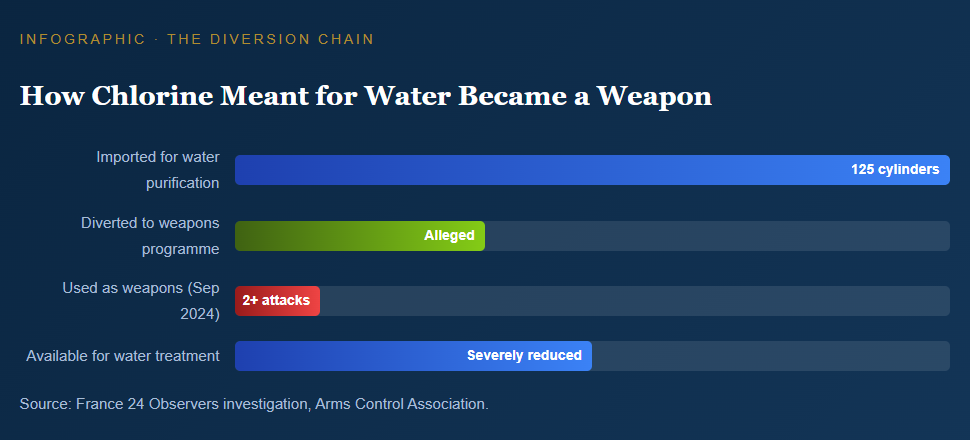
Source: France 24 Observers investigation, Arms Control Association. [1][4]
The Collapse of Water Infrastructure
The chemical weapons crisis unfolds against the backdrop of a wholesale collapse of Sudan’s water infrastructure. In Khartoum, the decline in Nile water levels has caused several water treatment plants that rely directly on the river to cease operations. Production at functioning plants has fallen by approximately 50%, leaving numerous neighbourhoods without running water and forcing residents to rely on untreated sources. [11]
In the El Salha area south of Omdurman, the main water station stopped operating when the Nile receded, leaving pumps stranded above the waterline. Thousands of families were left with no choice but to buy water at inflated prices or rely on brackish wells. [12] In El Obeid, North Kordofan, drone attacks have worsened an already dire water and fuel crisis, with the price of a litre of gasoline reaching nearly $15. Many people are using unsafe water sources. [13]
The situation is even more acute in displacement settings. In Tawila, North Darfur, where approximately 380,000 people have fled fighting near el-Fasher, residents survive on just 3 litres of water per day — less than half the emergency minimum of 7.5 litres per person. [10]
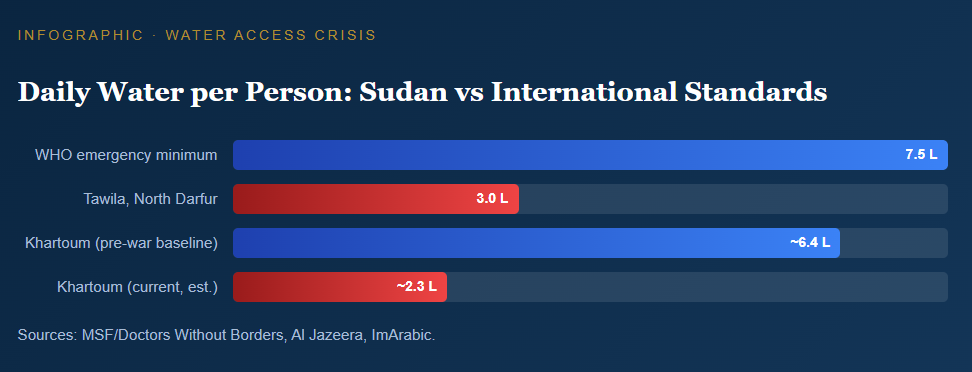
Sources: MSF/Doctors Without Borders, Al Jazeera, ImArabic. [10][11]
Public Health Impact: The Convergence of Chemical and Waterborne Threats
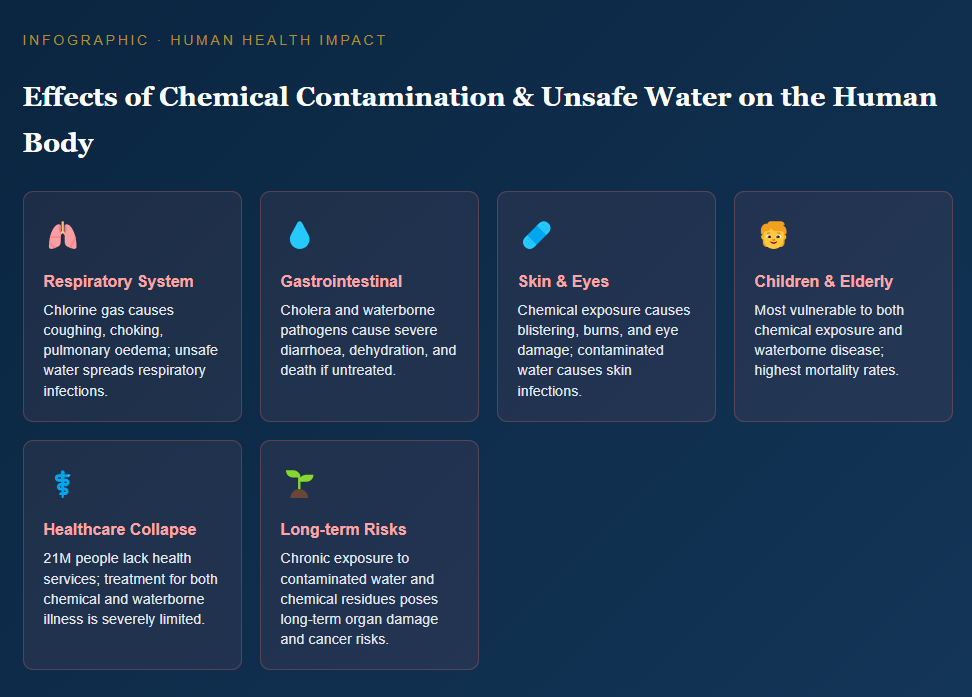
The intersection of chemical contamination and waterborne disease creates a compound public health emergency. Chlorine exposure causes severe respiratory distress, lung damage, skin lesions, and can be fatal. [5] At the same time, the collapse of water treatment and the reliance on unsafe water sources has triggered a cholera outbreak that, as of July 2026, had claimed over 114 lives and infected more than 1,330 people across Darfur and Kordofan. [8][14]
The WHO has warned that the outbreak could worsen as the war and the rainy season threaten to exacerbate the humanitarian crisis. More than three years of conflict have decimated Sudan’s healthcare system, with hospitals only partially functioning or closed due to destruction. [14][9] In addition to cholera, existing disease outbreaks include dengue, malaria, meningitis, hepatitis E, and measles. [8]
Legal Framework & the Accountability Gap
Sudan ratified the Chemical Weapons Convention in 1999, making it legally bound not to develop, produce, or use chemical weapons. [19] The use of chlorine as a weapon is prohibited under the CWC, and its use as an asphyxiating gas on the battlefield is classified as a war crime under the 1998 Rome Statute. [3][5]
At the OPCW Executive Council’s 112th session in The Hague in July 2026, the United States declared that its « rigorous, independent technical analysis » concluded the SAF used chemical weapons in 2024 and that the government remained in non-compliance with the CWC in 2025. Washington urged Sudan to submit a comprehensive declaration to the OPCW Technical Secretariat and grant inspectors immediate, transparent, and unrestricted access. [7][6]
However, the case has not been resolved internationally for several structural reasons. The OPCW Technical Secretariat has not received a sufficiently complete request to undertake field activity, and does not have the authority to take up the case on its own initiative. State sovereignty and access constraints mean the organisation requires the cooperation of the host state. In an active internal conflict, field implementation becomes virtually impossible without a mandate under Chapter VII of the UN Security Council. [17][18]
United Nations Concerns: Chemicals in Water as a Weapon
The United Nations has consistently and unequivocally condemned the use of chemical weapons under any circumstances, by anyone, anywhere. The UN Secretary-General has reaffirmed that « any use of chemical weapons, by anyone, under any circumstances, is a grave violation of the 1925 Protocol and other relevant rules of customary international law, » and that the use of chemical weapons constitutes a serious violation of international law and a threat to international peace and security. [21][22] In his message on the Day of Remembrance for All Victims of Chemical Warfare in November 2025 — marking the 100th anniversary of the 1925 Geneva Protocol — the Secretary-General warned that « the appalling use of chemical weapons has continued » and urged States to « reaffirm their commitment to a world free of these repugnant weapons. » [23][24]
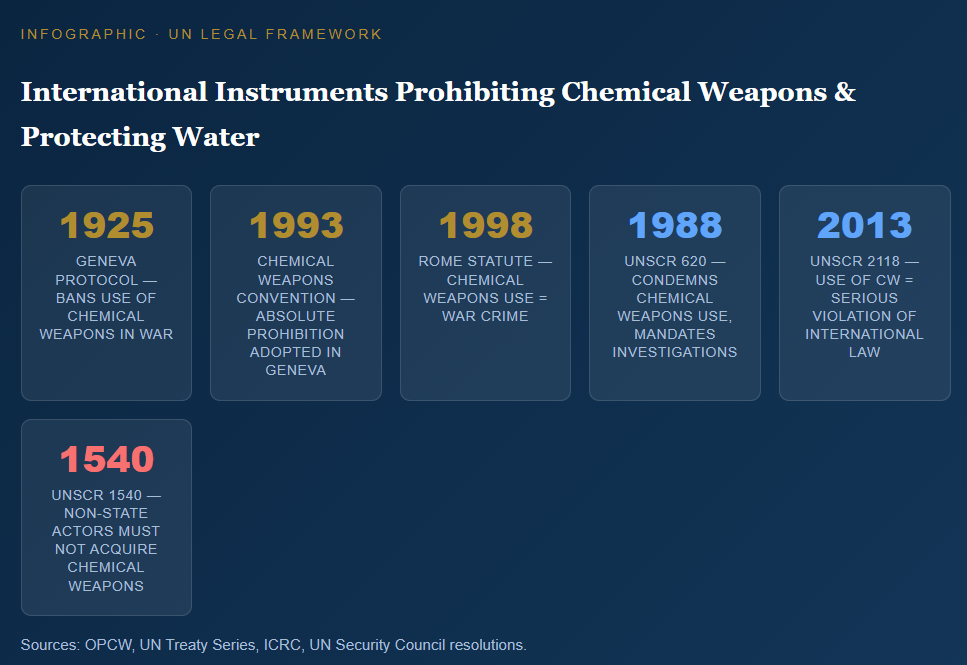
The legal framework governing the use of chemicals in water as a weapon is anchored in several binding instruments. The 1925 Geneva Protocol for the Prohibition of the Use in War of Asphyxiating, Poisonous or Other Gases, and of Bacteriological Methods of Warfare was the first international treaty to ban the use of chemical weapons, adopted after the devastating impact of poison gas in the First World War. [25][26] This was reinforced by the 1993 Chemical Weapons Convention (CWC), adopted at the Conference on Disarmament in Geneva, which extended the prohibition on use to the development, production, stockpiling, and transfer of chemical weapons, and established the OPCW as its implementing body. [19][27] The CWC’s prohibition is absolute and non-negotiable: under Article I, paragraph 1(b), States Parties undertake « never under any circumstances » to use chemical weapons. [6]
Crucially, the prohibition on the use of chemical weapons is now a rule of customary international humanitarian law, binding on all parties to all armed conflicts, whether States or non-State armed groups. The International Committee of the Red Cross (ICRC) has confirmed that the ban « is absolute and far-reaching, covering both improvised and classical chemical weapons. » [28] The use of asphyxiating or poisonous gases on the battlefield is further classified as a war crime under the 1998 Rome Statute of the International Criminal Court. [3]
The UN Security Council has reinforced these norms through multiple resolutions. Resolution 620 (1988) condemned the use of chemical weapons in the Iran-Iraq conflict and encouraged the Secretary-General to carry out prompt investigations into allegations of chemical weapons use. [29] Resolution 2118 (2013), adopted in response to the use of chemical weapons in Syria, affirmed that « the use of chemical weapons constitutes a serious violation of international law » and stressed that « those responsible for any use of chemical weapons must be held accountable. » [30] The Security Council has also determined that the use of chemical weapons anywhere constitutes a threat to international peace and security. [22]
Of particular relevance to Sudan is the emerging norm on the protection of water infrastructure in armed conflict. The Geneva List of Principles on the Protection of Water Infrastructure, developed at the University of Geneva, notes that recent armed conflicts on the agenda of the UN Security Council have been characterised by water-related issues, and that the Council has expressed « grave alarm at attacks against civilian infrastructure including deliberate interruptions of water supply » and called on all parties to comply with their obligations under international humanitarian law. [31] The deliberate contamination of water sources with chemical agents, or the diversion of water treatment chemicals into weapons, constitutes a compound violation: it breaches both the prohibition on chemical weapons use and the obligation to protect civilian water infrastructure and essential services.
Under the CWC, any State Party that has reason to believe another State Party is acting in breach of its obligations may lodge a complaint with the UN Security Council, which may initiate an investigation in accordance with the UN Charter. [32] In Sudan’s case, the United States has formally determined non-compliance, yet the absence of a Chapter VII mandate and Sudan’s refusal to grant the OPCW Technical Secretariat unhindered access have prevented independent on-site verification. [6][17] This accountability gap is precisely what the Geneva Policy Forum urges the international community to close — not only for the sake of chemical weapons justice, but to protect the fundamental right to safe water that the weaponisation of chlorine has so brutally violated.
Sources: OPCW, UN Treaty Series, ICRC, UN Security Council resolutions. [26][19][28][29][30]
Policy Recommendations
The Geneva Policy Forum calls on member states, the OPCW, UN agencies, and humanitarian actors to adopt the following integrated approach addressing both the chemical weapons accountability gap and the water security crisis:
RECOMMENDATION 1
Mandate an Independent OPCW Investigation
The UN Security Council should refer the matter to the OPCW under a Chapter VII mandate, enabling independent on-site verification of chemical weapons use and contamination of water sources. Sudan’s internal technical committee — compromised by the alleged inclusion of the programme’s architect — cannot substitute for international verification. [6][7]
RECOMMENDATION 2
Trace and Secure the Chlorine Supply Chain
The OPCW and member states should investigate the full chlorine supply chain from export to end-use, establishing export controls and end-use verification mechanisms to prevent the diversion of dual-use water treatment chemicals into weapons. The Chemtrade case demonstrates the urgent need for strengthened monitoring of chemical exports to conflict zones. [1][4]
RECOMMENDATION 3
Emergency WASH and Water Infrastructure Restoration
Humanitarian actors must receive unconditional access to restore water treatment infrastructure, distribute chlorine for legitimate water purification, and implement emergency WASH services — including safe water trucking, portable treatment units, and raised latrines in flood-prone displacement settings. Investment must address structural drivers, not just hygiene promotion. [15]
RECOMMENDATION 4
Link Sanctions to Conditional Engagement
Sanctions should be embedded within a framework of conditional engagement rather than serving merely as a punitive tool. Conditions should include cooperation with OPCW inspection missions, safeguarding humanitarian access, adherence to international humanitarian law, and transparency regarding chemical weapons claims. This approach encourages behavioural change by linking sanctions to specific legal requirements. [16]
RECOMMENDATION 5
Integrated Disease Surveillance and Chemical Contamination Monitoring
WHO and health actors should establish integrated surveillance that tracks both waterborne disease outbreaks and chemical contamination of water sources, recognising that the two crises are interlinked. This requires unhindered access to affected areas and investment in laboratory capacity to test water for both biological and chemical contaminants. [9][8]
RECOMMENDATION 6
Refer to the International Criminal Court
The use of chlorine as a weapon constitutes a war crime under the Rome Statute. The UN Security Council should consider referring the situation in Sudan to the International Criminal Court for investigation of chemical weapons use, as has been done previously for Sudan. While Sudan does not recognise the ICC’s jurisdiction, a Security Council referral would establish international legal accountability. [3]
Conclusion
The Sudan chemical water crisis reveals a devastating intersection of armed conflict, chemical weapons proliferation, and water insecurity. The alleged diversion of chlorine from water purification into weapons is not merely a violation of international law — it is a betrayal of the millions of Sudanese people who depend on that chlorine for safe drinking water. The resulting compound crisis of chemical exposure and waterborne disease demands a response that treats chemical weapons accountability and water security as two sides of the same coin.
The Geneva Policy Forum urges the international community to act with urgency: to mandate independent verification, to secure the chemical supply chain, to restore water infrastructure, and to ensure that those responsible for the weaponisation of a lifeline are held to account. The people of Sudan cannot wait.
TAGS #Sudan #ChemicalWeapons #WaterContamination #Chlorine #WaterSecurity #Cholera #OPCW #ChemicalWeaponsConvention #HumanitarianCrisis #GenevaPolicyForum #Accountability #Khartoum #AlJailiRefinery #WASH #PublicHealth #InternationalLaw #AlBurhan #WaterTreatment #UN #GenevaProtocol #RomeStatute #UNSecurityCouncil #CustomaryInternationalLaw
References
[1] France 24 — « Exclusive: The first proof of the use of chemical weapons in Sudan’s civil war » (29 November 2025). https://www.france24.com/en/tv-shows/the-observers/20251129-exclusive-first-proof-use-chemical-weapons-sudan-civil-war
[2] France 24 — « How did chlorine imported to Sudan for water purification end up being used as a poison gas? » (29 November 2025). https://www.france24.com/en/africa/20251129-sudan-chlorine-imports-investigation-water
[3] France 24 — « Videos show the Sudanese army’s use of chlorine gas as a weapon » (9 October 2025). https://www.france24.com/en/africa/20251009-chemical-weapons-sudan-part-1-investigation-attacks-chlorine-al-jaili-refinery
[4] Arms Control Association — « Sudan Army Said to Use Chlorine as Weapon » (January 2026). https://www.armscontrol.org/act/2026-01/news/sudan-army-said-use-chlorine-weapon
[5] Human Rights Watch — « Disturbing Reports of Sudan’s Military Using Chlorine Gas » (9 October 2025). https://www.hrw.org/news/2025/10/09/disturbing-reports-of-sudans-military-using-chlorine-gas
[6] OPCW — United States Statement at the 112th Session of the Executive Council, The Hague (July 2026). https://www.opcw.org/sites/default/files/documents/2026/07/United%20States%20of%20America_EC-112_Agenda%20Item%20Statement_ol_%28e%29%20Agenda%20Item%206%20%28e%29.pdf
[7] The National — « US demands immediate inspections of Sudan’s chemical weapons and warns of consequences » (11 July 2026). https://www.thenationalnews.com/news/mena/2026/07/11/us-demands-immediate-inspections-of-sudans-chemical-weapons-and-warns-of-consequences/
[8] UN News — « New cholera outbreak alert for Sudan’s war-weary communities » (10 July 2026). https://news.un.org/en/story/2026/07/1167913
[9] WHO EMRO — « After three years of conflict, Sudan faces a deeper health crisis » (14 April 2026). https://www.emro.who.int/sdn/sudan-news/after-three-years-of-conflict-sudan-faces-a-deeper-health-crisis.html
[10] Al Jazeera — « Cholera kills 40 as Sudan faces worst outbreak in years, says MSF » (14 August 2025). https://www.aljazeera.com/news/2025/8/14/cholera-kills-40-as-sudan-faces-worst-outbreak-in-years-says-msf
[11] ImArabic — « Khartoum Suffers Under the Strain of Thirst and Contaminated Water » (27 July 2026). https://en.imarabic.com/khartoum-suffers-under-the-strain-of-thirst-and-contaminated-water/
[12] Dabanga Sudan — « From abundance to retreat: what happened to Nile water levels in Sudan? » (16 July 2026). https://www.dabangasudan.org/en/all-news/article/from-abundance-to-retreat-what-happened-to-nile-water-levels-in-sudan
[13] Doctors Without Borders / MSF — « Sudan: Drone attacks are worsening a water and fuel crisis in El Obeid » (15 July 2026). https://www.doctorswithoutborders.org/latest/sudan-drone-attacks-are-worsening-water-and-fuel-crisis-el-obeid
[14] Africanews — « WHO warns Sudan’s cholera outbreak may worsen amid conflict and rains » (10 July 2026). https://www.africanews.com/2026/07/10/who-warns-sudans-cholera-outbreak-may-worsen-amid-conflict-and-rains/
[15] Springer / Conflict and Health — « Between bullets and outbreaks: epidemic control in Sudan’s forgotten war » (23 March 2026). https://link.springer.com/article/10.1186/s13031-026-00763-8
[16] ORF Online — « Building Accountability for Chemical Weapons Use in Sudan » (4 August 2026). https://www.orfonline.org/expert-speak/beyond-sanctions-building-accountability-for-chemical-weapons-use-in-sudan
[17] ImArabic — « Sudan and the OPCW: Why Has the Case Not Been Resolved Internationally? » (6 September 2026). https://en.imarabic.com/sudan-and-the-organisation-for-the-prohibition-of-chemical-weapons-why-has-the-case-not-been-resolved-internationally/
[18] ImArabic — « International Monitoring and Verification Mechanisms for Chemical Weapons in Sudan » (5 September 2026).
[19] UN Treaties — Chemical Weapons Convention, Sudan ratification (1999). https://treaties.un.org/pages/viewdetails.aspx?chapter=26&mtdsg_no=xxvi-3&src=treaty
[20] Africa Defense Forum — « Evidence Supports Claim That Sudan Army Used Chlorine Gas Against RSF » (October 2025). https://adf-magazine.com/2025/10/evidence-supports-claim-that-sudan-army-used-chlorine-gas-against-rsf/
[21] UN Secretary-General — Remarks on the Final Report of the UN Mission to Investigate Allegations of the Use of Chemical Weapons in Syria (16 December 2013). https://www.un.org/sg/en/content/sg/statement/2013-12-16/secretary-generals-remarks-the-final-report-of-the-un-mission-investigate-allegations-of-the-use-of-chemical-weapons-the-syrian-arab-republic-prepared-for-delivery
[22] UN Secretary-General — Statement attributable to the Spokesman on alleged chemical weapons attack in Idlib (4 April 2017). https://specialenvoysyria.unmissions.org/en/press-releases/statement-attributable-spokesman-secretary-general-alleged-chemical-weapons
[23] UN Secretary-General — Message on the Day of Remembrance for All Victims of Chemical Warfare (30 November 2025). https://www.un.org/sg/en/content/sg/statements/2025-11-30/secretary-generals-message-the-day-of-remembrance-for-all-victims-of-chemical-warfare
[24] UNIS Vienna — The Secretary-General: Message for the Day of Remembrance for All Victims of Chemical Warfare. https://unis.unvienna.org/unis/en/pressrels/2025/unissgsm1550.html
[25] UN Chronicle — « We Must Remain Committed to a World Free of Chemical Weapons » (6 January 2026). https://www.un.org/en/un-chronicle/we-must-remain-committed-world-free-chemical-weapons
[26] OPCW — Chemical Weapons Convention text, citing the 1925 Geneva Protocol. https://www.opcw.org/sites/default/files/documents/CWC/CWC_en.pdf
[27] UN Audiovisual Library of International Law — Convention on the Prohibition of Chemical Weapons. https://legal.un.org/avl/HA/cpdpsucw/cpdpsucw.html
[28] ICRC — « Chemical and biological weapons ». https://www.icrc.org/en/document/chemical-biological-weapons
[29] ICRC Casebook — « UN/ICRC, The Use of Chemical Weapons » (UNSCR 620). https://casebook.icrc.org/case-study/unicrc-use-chemical-weapons
[30] UN Security Council Resolution 2118 (2013) on Syria and chemical weapons.
[31] University of Geneva — « The Geneva List of Principles on the Protection of Water Infrastructure ». https://www.unige.ch/droit/eau/application/files/8216/7765/9568/gva_list_of_principles_protection_water_infra_www.pdf
[32] UN Treaty Series — Chemical Weapons Convention, Article X complaint mechanism. https://treaties.un.org/doc/Publication/UNTS/Volume%201108/volume-1108-I-17119-English.pdf