

Open-Source Intelligence (OSINT) Paper · August 2026
Region: Horn of Africa & Red Sea · Classification: OSINT / Unclassified
1. Executive Summary & Key Assessments
Available open-source information indicates that the relationship between Iran and authorities associated with the Sudanese Armed Forces (SAF) has, since the second half of 2023, moved from a phase of political and diplomatic re-engagement toward a more advanced level of cooperation with a military dimension.
Key Figures at a Glance
| Indicator | Value | Source |
| Alleged 2025 Mohajer-6 drone contract | $70 million+ | US DOJ criminal complaint (April 2026) |
| Qeshm Fars Air cargo flights, Iran–Port Sudan | 6 flights (Dec 2023–Jan 2024) | Reuters flight-tracking data |
| Civilian deaths from drone strikes (Jan–Apr 2026) | 880 | UN human rights office (OHCHR) |
| Fighters linked to the National Congress Party | ~5,000 | Reuters investigation (2025) |
Cross-checked evidence indicates that the most significant manifestations of this cooperation include the Sudanese Armed Forces’ acquisition of Iranian-made unmanned aerial vehicles and their use during the war, alongside air activity between Iran and Port Sudan, followed by subsequent indications that channels for negotiations and military contracting between the two sides continued.
However, open sources still do not provide sufficient evidence to establish the presence of a conventional Iranian combat deployment inside Sudan. Accordingly, this paper uses the term “Iranian military intervention” primarily to refer to military, technical, and logistical support, rather than to the presence of declared Iranian forces directly participating in operations.
Iran’s return came at a highly sensitive moment. After the Sudanese war erupted on 15 April 2023, Tehran and Khartoum began discussing the restoration of relations in July of the same year, after ties had been severed since 2016, before the two countries officially announced the resumption of diplomatic relations on 9 October 2023. The political channel reopened at a time when the SAF were facing considerable military pressure and seeking additional sources to strengthen their capabilities.
How the Evidence Converges — Four Independent Evidence Streams
| Evidence Stream | Relative Evidentiary Strength |
| Journalistic investigations | ████████████░░░░ 85% |
| Visual evidence (wreckage) | █████████████░░░ 92% |
| Flight-tracking data | █████████░░░░░░░ 78% |
| US judicial indicators | ████████░░░░░░░░░ 70% |
Key Intelligence Assessments
| # | Assessment | Confidence |
| 1 | Since at least late 2023, Iran has become an important source of unmanned military capabilities used by the SAF. | High |
| 2 | Iranian support contributed to improving some SAF operational capabilities, particularly surveillance and targeting — but was not the sole factor. | Medium–High |
| 3 | Tehran views military cooperation as a tool for rebuilding broader political and strategic influence, not merely arms-selling. | Medium |
| 4 | Islamist and former-regime networks are a contributing factor in restoring relations, but do not manage the cooperation. | Medium |
| 5 | The relationship is likely to continue even if the war’s intensity declines, especially if it institutionalizes. | Medium |
Overall Assessment: As of August 2026, open-source information does not indicate an Iranian military occupation or large-scale conventional combat deployment inside Sudan. It does, however, provide strong evidence of indirect military intervention based on arms supplies, technology, and defense relations — within a broader political trajectory aimed at re-establishing Iranian influence in Sudan.
2. From Estrangement to Return: A Three-Decade Arc
Iran’s return to Sudan after the April 2023 war cannot be understood as a new relationship created solely by the SAF’s need for military support. The current rapprochement rests on a political, security, and military legacy extending over more than three decades.
Timeline of Iran–Sudan Relations
| Date | Event |
| 1989 | Omar al-Bashir comes to power with the National Islamic Front. Sudan becomes one of Iran’s closest Arab and African partners. |
| 1990s | Cooperation in training Sudanese military/security personnel and transferring military expertise. |
| March 2008 | Defense ministers sign a military cooperation agreement; Iran among countries reportedly supplying arms to Sudan during Darfur scrutiny. |
| Oct 2012 – Sep 2013 | Port Sudan receives Iranian warships three times in under a year — demonstrating pre-existing military access to Sudan’s coast. |
| September 2014 | Sudan closes Iranian cultural centers and expels the cultural attaché — publicly revealing political limits to Iranian influence. |
| 4 January 2016 | Sudan severs diplomatic relations with Iran, aligning with Riyadh after joining the Saudi-led coalition in Yemen. |
| April 2019 | Fall of Bashir; Islamist movement and National Congress Party networks significantly weakened. |
| 15 April 2023 | Sudan war erupts; SAF face major battlefield challenges. |
| 6 July 2023 | Foreign ministers meet in Baku — first publicly announced meeting at this level since the rupture. |
| 9 October 2023 | Formal announcement of restored diplomatic relations after seven years. |
| Dec 2023 – Jan 2024 | Six Qeshm Fars Air cargo flights between Iran and Port Sudan. |
| January 2024 | Wreckage of an Iranian Mohajer-6 drone documented; more effective drones appear in operations. |
| July 2024 | Iran and Sudan exchange ambassadors — full diplomatic representation. |
| September 2025 | US Treasury sanctions Gibril Ibrahim and the Al-Baraa ibn Malik Brigade, linking them to Iran and the IRGC. |
| March 2026 | US designates the “Sudanese Muslim Brotherhood,” linking elements to IRGC support and training. |
| April 2026 | US DOJ announces arrest of an Iranian national; $70M+ Mohajer-6 contract alleged. |
| May–July 2026 | UN warns of expanding drone use; 880 civilian deaths reported Jan–Apr 2026. |
The diplomatic rupture in 2016 did not erase the institutional history of the relationship. Sudanese state institutions and individuals retained experience from dealing with Iran during the Bashir era. When Sudanese actors needed to reopen a channel after 2023, the relationship was not being built from scratch — it rested on institutional memory and previously established communication networks.
Intelligence Assessment: Iran’s return was not the result of an ideological awakening inside Sudan, but a process of restoring an old relationship under conditions created by the war. The military and security legacy of the Bashir era created an institutional foundation that facilitated rapprochement after 2023. The operational role of Islamist networks in the current cooperation requires independent analysis.
3. Nature & Operational Impact of the Intervention
Open sources support, with high confidence, describing Iran’s role in Sudan as indirect military intervention, primarily based on the transfer of military capabilities and technology to the SAF rather than the deployment of Iranian combat units.
The Three Levels of Intervention
| Level | Description | Confidence |
| 1. Equipment Supply | Transfer of drone systems such as the Mohajer-6 — established through visual identification and wreckage analysis. | High |
| 2. Training & Technical Support | Functionally plausible — training abroad, knowledge transfer, or limited technical teams — but requires additional evidence. | Low–Medium |
| 3. Direct Combat Participation | No open-source evidence establishes IRGC units or Iranian personnel directly participating in combat operations. | Unproven |
Drone Systems: The Clearest Evidence
| System | Origin | Evidence Basis | Confidence |
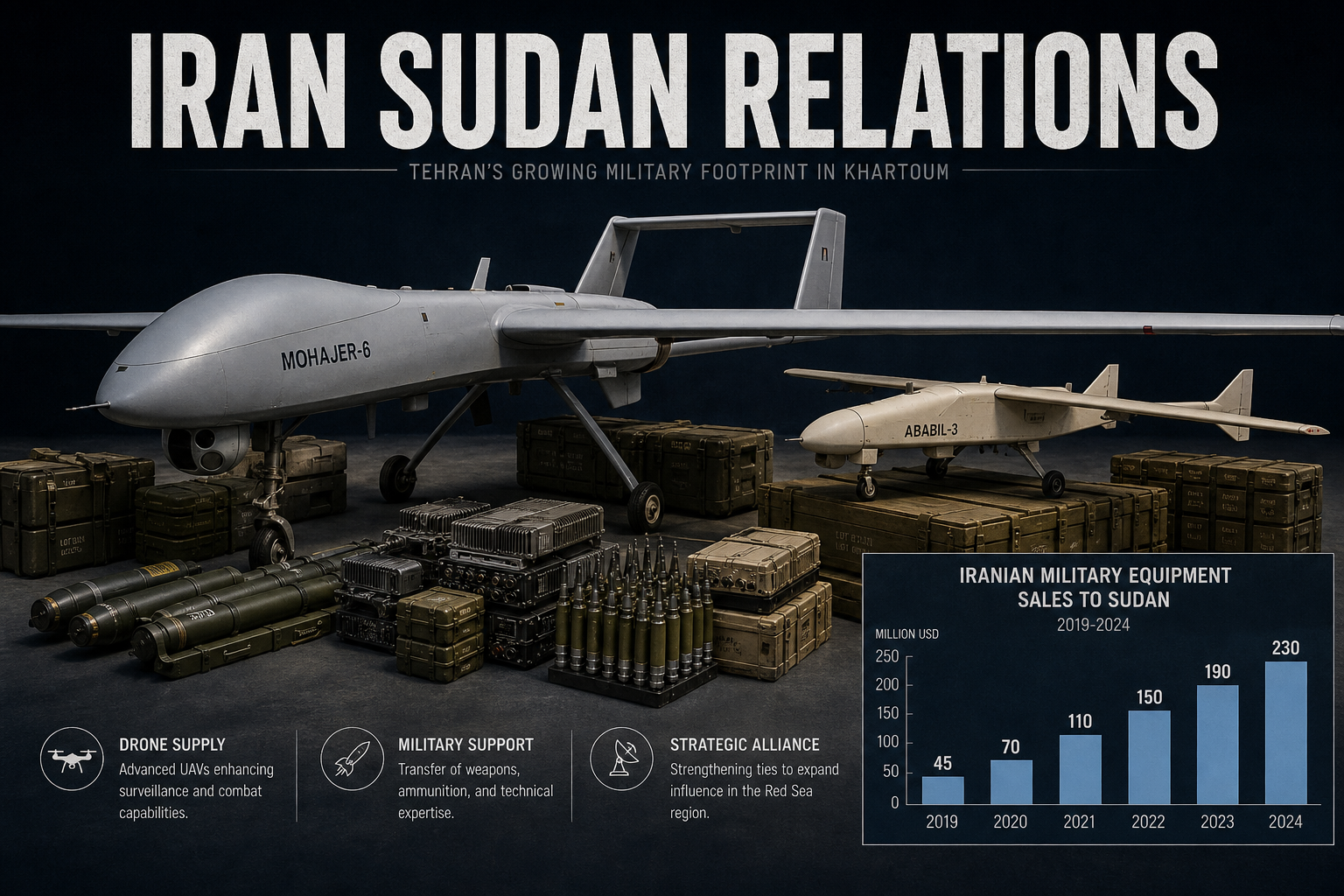
| Mohajer-6 | Iran | Wreckage identified Jan 2024 (HRW); visual/OSINT analysis | High |
| Ababil family | Iran | EU Agency for Asylum assessment; ACLED analysis | Medium |
| Ababil-3 | Iran | ACLED analysis of drone mix used by SAF | Medium |
Iranian Drone Systems Identified in Sudan — Evidence Strength
| System | Visual/physical evidence | Report convergence |
| Mohajer-6 | ██████████████████ 90% | ███████████████ 75% |
| Ababil family | ███████ 35% | ██████████████ 70% |
| Ababil-3 | █████ 25% | ████████████ 60% |
The Air Bridge Between Iran and Port Sudan
Flight-tracking data reviewed by Reuters showed that a cargo aircraft operated by Qeshm Fars Air made six flights between Iran and Port Sudan during December 2023 and January 2024, directly before and during the period in which more advanced Iranian systems began appearing in operations.
Qeshm Fars Air Cargo Flights: Iran ⇄ Port Sudan
| Period | Number of Flights |
| December 2023 | 3 |
| January 2024 | 3 |
| Total | 6 |
The existence of the flights is established to a higher degree than the contents of the shipments. Nevertheless, the combination of indicators — timing of flights, restoration of diplomatic relations shortly beforehand, the subsequent appearance of Iranian systems, and sources describing military transfers — makes the hypothesis that the flights formed part of a military supply bridge highly plausible.
From Emergency Shipments to Military Contracting
Developments in the United States during 2026 provide another indication that the relationship may have gradually evolved toward more institutional arrangements. In April 2026, the US Department of Justice announced the arrest of an Iranian national accused of facilitating military transactions with Sudan, including a contract worth more than $70 million for the sale of Mohajer-6 drones from Iran’s Ministry of Defense to Sudan’s military establishment.
These remain judicial allegations rather than facts established by a final judgment. Nevertheless, the nature and scale of the alleged transaction — if confirmed — point toward a more organized relationship than the emergency shipment of limited systems, suggesting two phases: a rapid response to the SAF’s need for UAV capabilities in late 2023/early 2024, followed by a more organized relationship with Iran’s defense-industrial sector.
4. The Former Regime & Islamist Political Networks
Political Islam represents one of the most complex elements in explaining Iran’s return — not because the current relationship can be reduced to an ideological alliance, but because the Islamist movement and Bashir-era networks were historically part of the environment in which Iranian-Sudanese relations were built.
A 2025 Reuters investigation found that networks associated with the former regime participated in mobilization and combat, with the number of fighters directly associated with the National Congress Party possibly reaching approximately 5,000.
Three Levels of the Islamist–Iran Connection
| Level | Description | Confidence |
| 1 | Historical relations & networks reactivated alongside the army | ██████████████████ 88% (High) |
| 2 | Islamist figures used Iran links during the war | █████████████ 68% (Medium–High) |
| 3 | Islamists = principal/exclusive channel for military agreements | ██████ 30% (Unproven) |
US measures increased the weight of the hypothesis that direct channels exist between some Sudanese Islamist components and Iran. In September 2025, the US Treasury linked the Al-Baraa ibn Malik Brigade to Iranian support and the Revolutionary Guard, and in March 2026 Washington designated what it described as the Sudanese Muslim Brotherhood.
Are the Islamists Iran’s gateway to the army? Available evidence allows three levels to be identified: (1) longstanding historical relations — high confidence; (2) some Islamist figures retained direct relations with Iran and used them during the war — medium–high confidence; (3) that Islamists were the principal or exclusive channel for military agreements — unproven. After diplomatic relations were restored, the Sudanese military leadership could communicate directly with Iran through state institutions without requiring an Islamist intermediary.
5. What Does Iran Want from Sudan and the Red Sea?
Iran’s interest in Sudan does not appear explainable through revenues from drone and arms sales alone. Sudan occupies a strategic position on the western coast of the Red Sea, and Tehran’s return coincided with the growing importance of this maritime corridor in regional security calculations.
Iranian Interests in Sudan: Two Interconnected Levels
1. Direct & Tactical: Building a relationship with a military institution dependent on new weapons sources — expanding the network of countries using Iranian systems and consolidating Iran’s position as a supplier turned to when Western options are limited.
2. Strategic: Using the military relationship to build political and security influence exploitable after the war. Sudan’s geographic position becomes more important than its purchasing power — a long Red Sea coastline connecting Northeast Africa, the Horn, and the Arab world.
Did Iran Request a Naval Base?
In March 2024, the Wall Street Journal reportedly cited a senior Sudanese intelligence official saying Iran had sought to establish a permanent naval base on the Red Sea coast, offering advanced weapons; the Sudanese side reportedly rejected the offer. The claim was met with denials from both sides, and no final agreement or official document was publicly released.
Red Sea Naval Access — OSINT Classification
| Claim | Classification |
| Iranian strategic interest in the Red Sea | ███████████████████ 95% — High confidence |
| Reports of a naval-base request | ████████████ 60% — Credible / monitor |
| Iran obtained a base / authorization | ██ 12% — Unproven |
Iran may not need a “base” in the traditional sense. From an influence perspective, Iran could instead seek limited port access, recurring naval visits, maintenance arrangements, maritime security cooperation, or the presence of companies associated with port services. Such arrangements would be more politically manageable while providing many of the benefits of a formal base. Port Sudan received Iranian warships in 2012 and 2013 without this developing into a permanent base.
6. Strategic Alliance or Transaction of Interests?
The existence of evidence that the SAF receive Iranian military support does not necessarily mean that Khartoum has become a strategic ally of Tehran. A review of the army’s external relations during the war shows a more pragmatic policy based on diversifying sources of support.
SAF’s “Multiple Strategic Suppliers”
| Partner | Relationship Intensity (relative) |
| Egypt | █████████████████ 85% |
| Saudi Arabia | ████████████████ 80% |
| Turkey | ███████████████ 75% |
| Qatar | ██████████████ 70% |
| Iran | █████████████ 65% |
Alongside Iran, the SAF have maintained varying degrees of close relations with Egypt, Saudi Arabia, Qatar, and Turkey, and have used military systems from multiple sources. This plurality can be described as a strategy of “multiple strategic suppliers” — the army does not need to choose a single axis if it can obtain different types of support from different partners.
The relationship therefore rests on a clear exchange of needs: the army needs capabilities and partners, while Iran needs access and influence. The exchange, however, is not perfectly balanced — as the army’s external options increase, Iran’s ability to convert support into political influence declines.
Constraints on Iranian Influence
- Regional plurality: The army’s continuing relationships with Egypt, Saudi Arabia, Turkey, and Qatar.
- Economic interests: Sudan’s long-term economy is tied to the Arab world, the Gulf, and international institutions — making full alignment with Iran costly.
- Historical precedent: Khartoum abandoned a close relationship with Tehran in 2016 when its regional priorities changed.
7. Final Assessment: Information Gaps & Future Scenarios
The overall open-source evidence indicates that Iranian intervention in Sudan moved, since late 2023, from the restoration of political relations toward an actual defense relationship with observable military effects. Its most prominent manifestation has been the arrival of Iranian-origin drones, accompanied by logistical activity between Iran and Port Sudan.
Future Scenarios — Probability Assessment (Aug 2026)
| Scenario | Assessed Probability |
| 1. Alliance of necessity (near term) — relationship stays within interest-based limits | █████████████████ 78% |
| 2. Long-term institutional defense partnership | ██████████ 50% |
| 3. Iranian influence extends to the Red Sea | █████ 25% |
Major Intelligence Gaps
| Gap | Status |
| Actual scale of Iranian military supply | No complete picture of overall arms transfers, number of systems, or financial terms. |
| Nature of technical support | Unclear whether support is limited to training abroad or includes Iranian experts inside Sudan. |
| IRGC connection | US sanctions indicate channels exist, but full size and whether they are the official channel remain unestablished. |
| Future of maritime relations | No evidence of an Iranian base; ambiguous forms of cooperation may prove more significant. |
Early-Warning Indicators
- New institutional defense cooperation; continuation or expansion of military contracts.
- Credible evidence of Iranian technical training or support inside Sudan.
- Regular expansion of relations between defense institutions; any maritime cooperation.
- Return of Iranian military vessels to Sudanese ports on a regular basis.
- Change in the position of Islamist forces within postwar institutions.
- Response of Saudi Arabia and Egypt — opposition or more attractive alternatives.
Final Intelligence Assessment: Iranian military intervention in Sudan is established at the level of arms supply and defense support, but it has not yet developed into Iranian military or political dominance. The decisive indicator is not the continued arrival of Iranian weapons, but the transition in the relationship from “support during the war” to “institutional dependency after the war.” If this transition occurs, it would signal a genuine strategic shift. If Khartoum maintains a diversity of partners, Iran’s return will remain significant but limited by the boundaries of the interest-based arrangement the war has produced.
References
- Human Rights Watch (HRW). Analysis of visual and open-source information documenting Sudanese Armed Forces’ use of Iranian Mohajer-6 drones, including wreckage photographs, January 2024.
- Reuters. Investigative reporting (2023–2025) on Iran–Sudan military cooperation, Qeshm Fars Air cargo flights between Iran and Port Sudan, drone acquisition, and Islamist networks — citing Iranian, regional, diplomatic, and military sources.
- US Department of Justice & US Department of the Treasury. Criminal complaint (April 2026) on the arrest of an Iranian national and the alleged $70M+ Mohajer-6 drone contract; sanctions designations (September 2025) of Gibril Ibrahim and the Al-Baraa ibn Malik Brigade; designation of the “Sudanese Muslim Brotherhood” (March 2026).
- European Union Agency for Asylum (EUAA). Assessment of the security situation in Sudan, reporting Iranian material support including Mohajer-6 and Ababil drones and weapons transfers via flights to Port Sudan.
- ACLED (Armed Conflict Location & Event Data). Analysis of the drone mix used by Sudanese armed forces, including Mohajer-6 and Ababil-3, and the diversification of drone sources across geographically separated fronts.
- United Nations human rights office (OHCHR). Warnings (May–July 2026) on the expanding use of drones in the Sudan war, reporting at least 880 civilian deaths from drone strikes between January and April 2026.
This paper is an open-source intelligence (OSINT) assessment. Allegations referenced from judicial complaints and sanctions designations remain unproven absent final judgment. Confidence levels reflect the strength of publicly available evidence, not classified intelligence.